
Endangered eagles return to Chernobyl
Researchers from the British Trust for Ornithology (BTO) have been collaborating with scientists in Belarus to assess the state of wildlife in the Chernobyl Exclusion Zone (CEZ), and some species appear to be faring rather well.
Greater Spotted Eagles had become locally extinct before the nuclear accident but have since moved back into the area, with the lack of human activity and natural re-wetting of a large area of the CEZ allowing them to thrive. The species is Endangered in Europe and considered an indicator of wetland habitat quality. As many as 13 pairs were breeding in the CEZ at the last count.
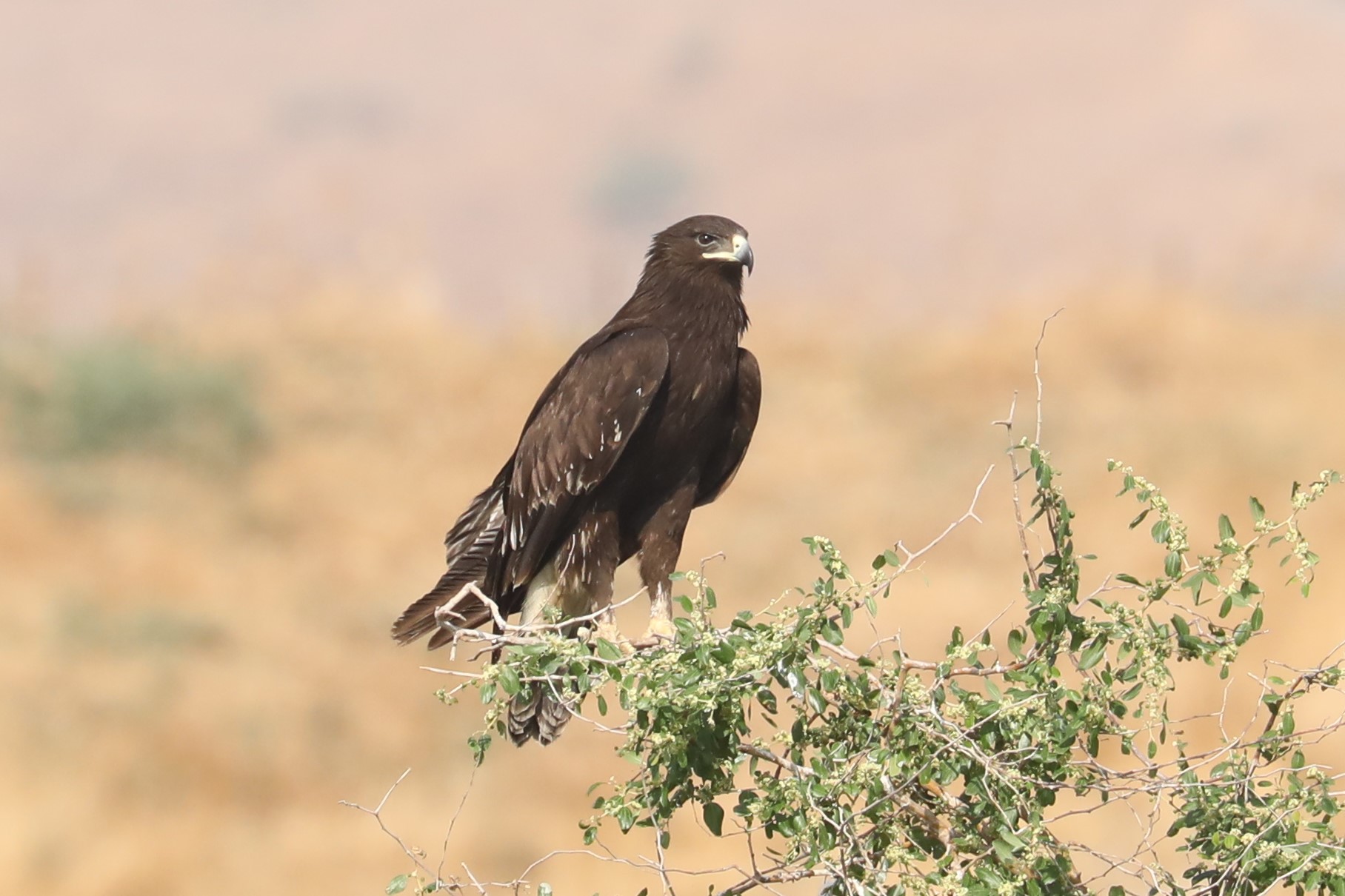
Greater Spotted Eagle has benefited from the lack of human activity since the infamous disaster in Ukraine (Matthew Mellor).
It is not the only species of eagle to bounce back in the area. White-tailed Eagle had also vanished by the time of the disaster but has started to breed in the CEZ again. These are resident, unlike Greater Spotted Eagles, and probably benefit from the carrion left by wolves. With hunting illegal in the area, wolves and other mammals have been allowed to return, and the benefit to the eagles demonstrates the restored health of the zone's ecosystem.
Data on the birds of prey in the CEZ has been gathered since 1998 by Valery Dombrovski, an eagle expert from Belarus. This has helped scientists analyse how the incidental rewilding in the exclusion zone has affected the species present. They found that generalist predators had become abundant since the accident, only to decline with succession of open habitats. As old drainage canals collapsed and blocked, the land became waterlogged, leading to a proliferation of wetland species. Eventually, the composition of raptor species in the CEZ came to resemble existing 'wild' sites in Belarus, like extensive mires and raised bogs, and less like that of agricultural land and commercial forestry.
Dr Adham Ashton-Butt, lead BTO scientist on the project, said: "Our work shows that rewilding could be a valuable method to conserve threatened species and restore ecoystems."
He added, "Rewilding, or restoration with reduced management, is becoming an increasingly employed method to deal with the global biodiversity and climate change crisis. However, long-term data on the impact of rewilding on wildlife communities are scarce or non-existent. Our dataset offers a rare exception, allowing us to show the effects on birds of prey over thirty years and land-abandonment of a previously intensively farmed area."
There were clear changes in the populations of breeding raptors over the study period, with some species fluctuating after humans left the area. In general, apex predators and wetland specialists, like Greater Spotted Eagle, increased with the flooding of former agricultural land. Generalist species and farmland specialists, like Common Buzzard and Montagu's Harrier, which increased initially, then suffered sharp declines, only to stabilise after a few years. Lesser Spotted Eagle, which has spread west at the cost of the closely related Greater Spotted Eagle in other areas, showed ongoing declines, bucking the national trend.
Reference
Dombrovski, V C, Zhurauliou, D Z, & Ashton-Butt, A. 2022. Long-term Effects of Rewilding on Species Composition: 22-years of Raptor Monitoring in the Chernobyl Exclusion Zone. Restoration Ecology. DOI: https://doi.org/10.1111/rec.13633
