
As I sit to write this, on a glorious day in late March, with rain, intense hail, bright skies and sunshine on rotation for much of the day, it's the beginning of a busy time for many of our resident bird species, as they try to find a mate and defend a territory. Many of our summer migrants are grappling with everything migration throws at them, but will hopefully be here in force by the time you read this.
The spectacle that is bird courtship display has been playing out for some species already. Over the late winter months, I've been enjoying duck-watching at my local patch and revelled in the delight of seeing Mallard displaying. I don't think I'd ever previously taken the time to properly notice and absorb the Mallard courtship display. I'd also stopped to watch Eurasian Teal showing off to one another as I could hear their excited whistles on my approach to the water's edge. It turns out that their courtship display is pretty similar to Mallard – a brief head shake, vertical neck stretch with beak tucked downwards towards the breast, a flick of the head up, round and back, while simultaneously raising their tail in the air to give a U-shaped profile and an undertail flash, followed by head and tail returning to resting position and, for teal, a 45-degree pirouette. Quick as a flash.
This is performed in small groups of drakes, with a couple of females in the mix to witness their moves. Other dabbling duck, such as Northern Pintail, Gadwall and Eurasian Wigeon, also perform a similar dance routine.
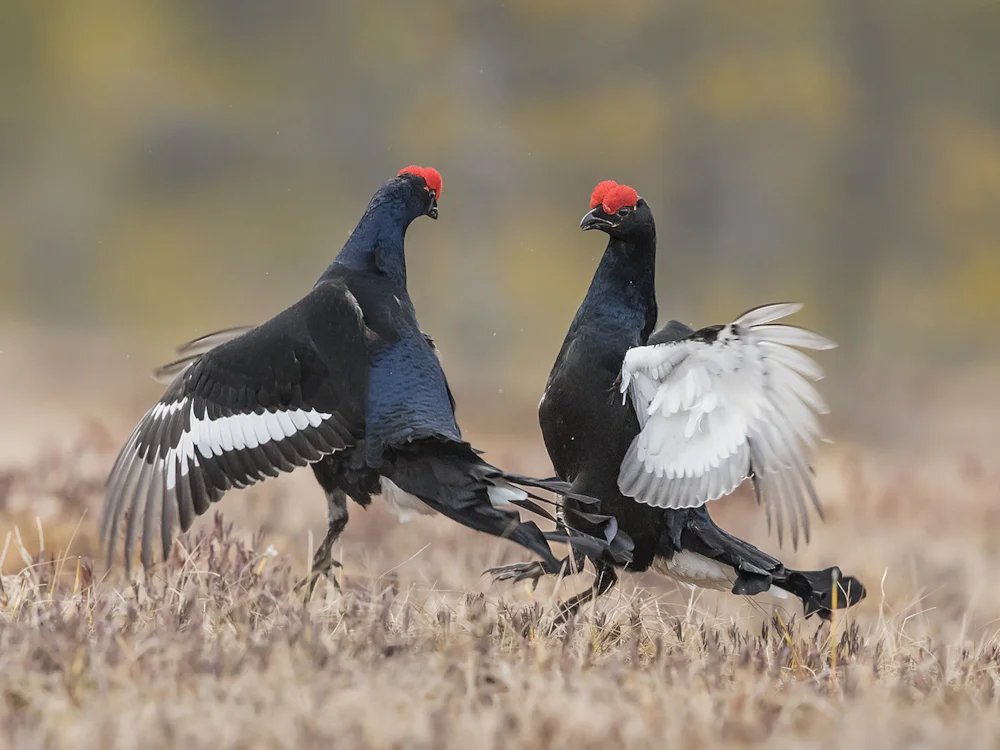
A Black Grouse lek is spectacular. Males gather at dawn and display by fanning out their white undertail feathers and lyre-shaped outertail feathers, while uttering strange bubbling sounds (Jamie MacArthur).
Raptor action
Eurasian Goshawks settle down to nest from late March into April, having occupied their home range year-round. There is a need then to reinstate their presence and mark their intention to breed, or, where lone birds reside, to attract a mate. Goshawk displays are performed by both males and females; slow-motion deep wingbeats as they rise above their forest home, white undertail coverts fanned and tail held tight, followed by some aerial acrobatics such as soaring in tight circles, undulating and even plunging with wings closed as they descend steeply before spectacularly 'bouncing' back up, sometimes not even opening their wings at stalling point, before roaring down again. This may continue for several 'loops' and end in a dramatic stoop into the forest canopy.
The exhilarating displays of goshawk are mirrored in other raptor species, demonstrating to anyone watching their strength, skill and manoeuvrability in flight – important qualities in a partner who will need to hunt well to provide for incubating females and the resulting young. Goshawk display is often called a 'sky dance', which is also the nickname given to Hen Harrier's performance whereby males carry out an undulating display, flying the 'right way up', interspersing this with flying upside down, and accompanying the display with an enchanting chattering call.
From sky dancers to a rollercoaster display: the mighty Common Buzzard! I hold this species close to my heart. As a child, buzzards were just starting to re-establish around my local area and I remember running outside whenever I had a call from a fellow birder saying that one was cruising overhead. Now, on a bright spring day, it's hard to look up and not see a buzzard soaring overhead following an increase of 89% across the UK since 1995. Their courtship displays are, in my opinion, among the best. Again, an undulating flight is staggered once height is gained by the birds literally flinging themselves up and over, wings closed, into a twisting and rapid descent, before open wings are met with the updraft, launching the birds back up to a higher altitude, before the freefall once again. Buzzards also twist their wings in a cupping motion in flight to flash the white patches at the base of the dark wing-tip fingers to other individuals in the area.
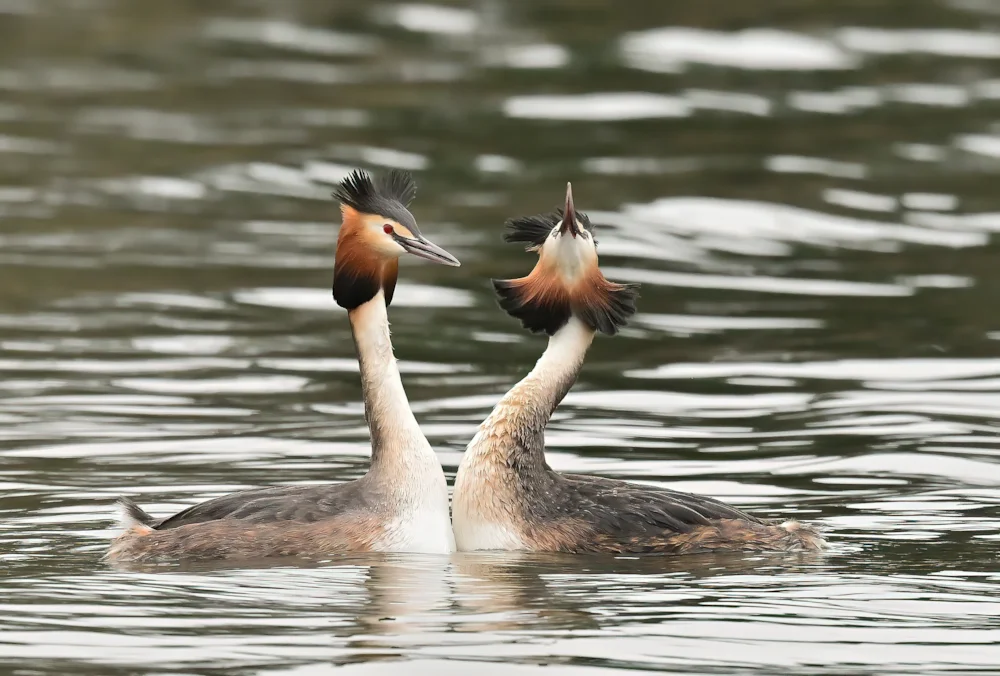
Great Crested Grebe pairs are well known for their elaborate, engaging courtship (Rob Bendelow).
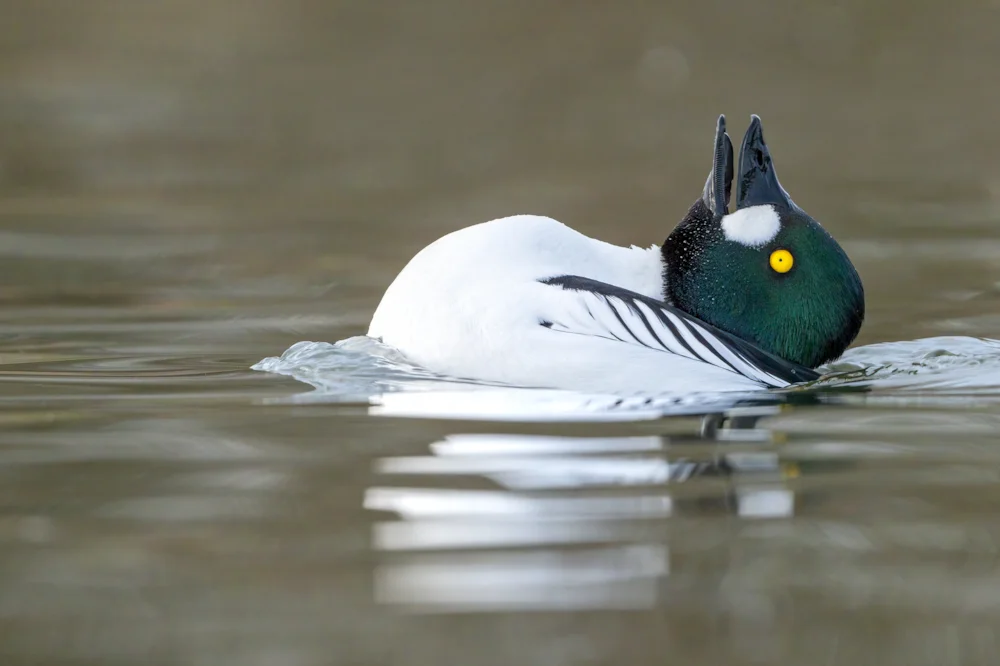
The bizarre posture being adopted by this male Common Goldeneye shows it midway through display. The drakes throw back their head until it touches their back, uttering a curious squeaky call while doing so (Romano Da Costa).
The need to show off
But what is it all about? Ultimately, display is a primal urge that spurs on the desire to carry out a courtship and successfully reproduce, but its immediate aim and purpose varies. For many birds, it is a demonstration of strength and endurance, a way to prove themselves a worthy mate or a real threat if you were thinking of muscling in on their turf. This demonstration is most often conducted by a physical display or song, but can also be shown through a fine and healthy plumage. Birds can moult into an impressive new outfit; for example, duck moulting out of their more subdued 'eclipse' plumage into their impressive winter wardrobe. They can also possess feathers where the tips wear down over time to reveal a 'new' outfit of protected patterning below in the run-up to the breeding season. An example of this latter strategy is the pale tips to the feathers on a male Reed Bunting's head which wear down to expose the smart black base of the feathers underneath. Additional accessories such as streamers and plumes might complete the look for some species, such as an Arctic Tern's tail and a Little Egret's head plumes.
A lek is also a good place to show off your strength, endurance and visual assets, joining together with other males in the hope of outshining the rivals and enticing an onlooking female to pair up. A bit like a nightclub, but less cringeworthy. Black Grouse, in my opinion, perform the best lek in Britain: an early morning start, the birds' breath revealed as vapour in the cold air as they build a truly tantalising atmosphere with rasping and mumbling bubbly calls. This is accompanied by the males puffing themselves up with their white undertail coverts raised up and on show, framed by their fanned tail which elaborately curves downwards at the end of each tail feather tip. Their red 'eyebrows' contrast against the black-and-white plumage, and their white carpal (shoulder) patches and wing-bars are flashed when they jump intimidatingly towards a rival male.
A further form of display is that of a bonding pair. This could be in the form of a dance duet or an aerial food pass, or simply a male provisioning for the female. One study at Cambridge University, using captive Eurasian Jays, discovered that a male will choose food for his partner that he has learnt is a firm favourite of hers, even when it's not something he thinks is most desirable himself – what a guy!
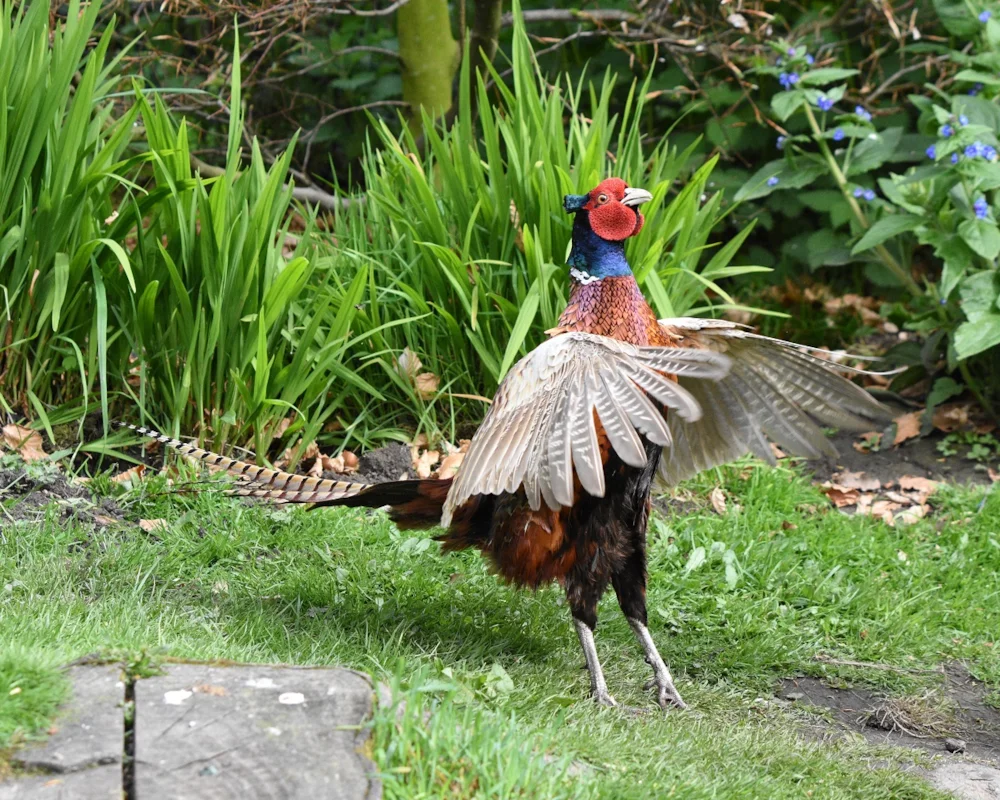
Male Common Pheasant will often display from a raised area, cocking their head back and calling while flapping their wings to show off to any nearby females (Irene Harrison).
Bonding moves
One of the most spectacular courtship displays in Britain is that of Great Crested Grebe – a fine example of a pair-bonding display. This species is well adapted for life on the water, with legs set far back on the body to equip it for diving for prey. This physical adaptation also means that the courtship display, which in part involves assuming in a vertical position, is rather graceful. The display is a fine duet, complete with weedy props!
The pair will come together on the water, with their rather flamboyant headwear splayed. Sitting facing one another, with necks extended, they will shake and bob their heads, and look side to side, starting to mirror one another's moves. If this goes well, the display culminates in a face-to-face meeting while holding pondweed in their beaks. They'll rise up onto their 'tip-toes', treading water, necks extended and again, looking side to side in perfect synchrony, waving the weed about. This must be one of the most famous displays in Britain, and one which can be seen across much of the UK, with the exception of the highlands of Scotland.
Another pair-bonding display is demonstrated by Common Cranes. We are lucky enough to now have this species at an increasing number of sites and they are famed for their courtship dance, which is described as 'jumping like ballerinas'. But let's be honest, the very best thing about their display is the loud declaration of intent with a trumpet-like medium-pitched, slightly harsh but big kaw-ka-ka cry as the birds throw their heads back in unison to call. The dancing part for me (noting that I couldn't do better) involves a lot of jumping about, wing flapping, bowing and head bobbing. There is an ever-increasing chance to witness this elaborate show at several reserves, from Slimbridge WWT in Gloucestershire to Loch of Strathbeg RSPB in Aberdeenshire.
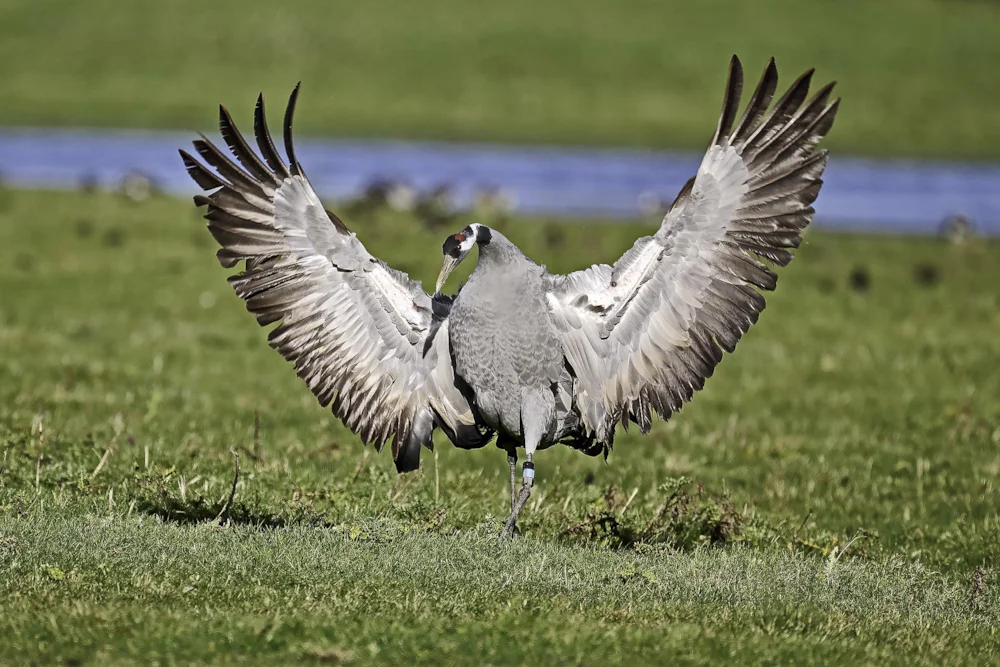
Common Crane has increased in Britain in recent years, meaning it's possible to enjoy the species' display in certain parts of the country. These enormous birds perform in flocks, with the courtship involving the opening of their wings and leaping up in the air, often while calling (Geof Slocombe).
Displaying on your doorstep
It often appears that many of our most extravagant bird displays are from rarer breeding species in Britain – but amazing courtship can be enjoyed in your garden or local park. There are a few common birds I am keen to bring to the fore when highlighting our brilliant breeding bird displays. One of them is Greenfinch, a species that has declined alarmingly across the UK. If anything is going to spur you on to keep your feeders clean and help reduce the spread of Trichomoniasis in your garden – a disease often deadly to Greenfinches – it will be seeing their endearing display flight. Their 'standard' song of twittering and trills ending with a drawn out, nasal wheeze is a familiar spring sound, but watch closely and you might glimpse their beautiful display flight, complete with soundtrack. Males start by sitting at the top of a tree before zipping up to complete a circular flight, twitching from side to side, with slow wingbeats – known as a butterfly-flight, often looking like a meandering hirundine – all the while twittering and trilling before returning to their perch. And while we're on finches, check out Goldfinch display – bolt upright with a sideways tail shift and branch shuffle!
Another to mention is the humble Blue Tit. These too fly up into the sky before a gradual gliding descent, on outstretched wings, back down to the place they started. It's a good one to look out for, especially if you have birds showing an interest in a nest site in your vicinity.
While Dunnock is often thought of as a shy and elusive species, it is fact one of the most promiscuous birds in Britain, with females often raising chicks in the same brood with different fathers. The males therefore hope to hold a territory and one way to show dominance in an area is to flutter their wings, flicking them open and up, flashing their underwings, interspersed with bouts of song. In the complex world of Dunnocks, some territories have both an 'alpha' (the dominant male) and a 'beta' male. Both can be seen to work together performing the territorial displays and chasing off intruding males, and although the alpha bird does attempt to guard the female most of the time, when she does manage to slip away and meet the beta male, the inevitable often happens. This leads to a broader gene pool among the nest of chicks and two males helping the female to raise the brood.
And finally for the garden display selection: Woodpigeon! It's always worth watching these birds fly up into the sky, clapping their wings together a couple of times, and then gliding steeply and gracefully downwards before heading back up to repeat the performance. If a female appears interested, the male will approach her puffed up, head-bobbing and bowing down with tail up and splayed, while purring in the hope of successfully winning his mate.
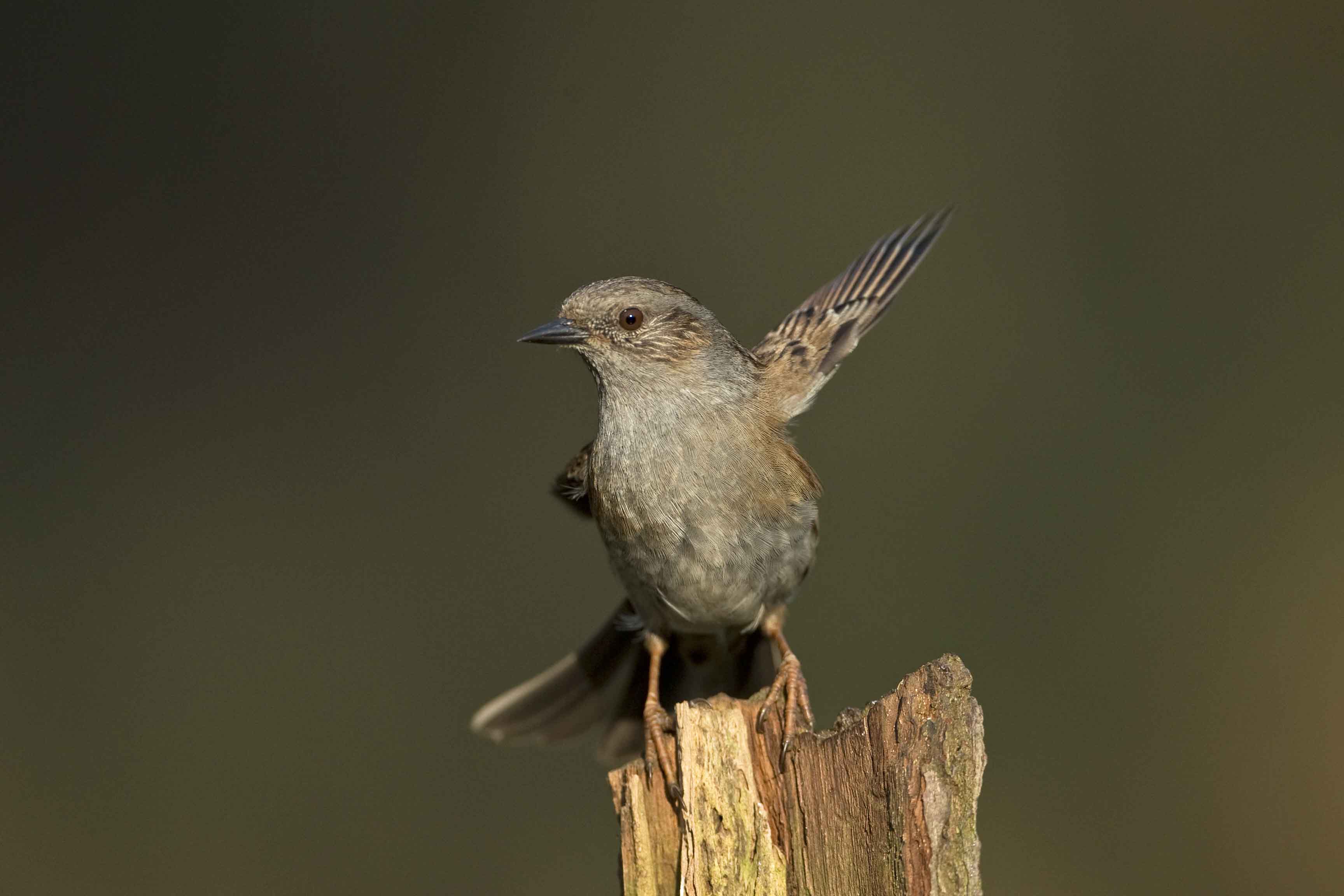
This Dunnock has been captured while fluttering its wings, a rather discreet display which territorial males perform when laying claim to their area or mate (Robin Chittenden).
After dark
During a countryside walk, you might suddenly see a small bird in full song ping out the hedgerow alongside you, rising up, crest up and tail fanned before jerking about in mid-air and messily descending back into the vegetation, all the while singing a rapid and scratchy song – Common Whitethroat, a real sound of summer. My favourite bird, Sedge Warbler, does a similar thing. Their singing culminates in them catapulting up in the air, ascending with rapid wingbeats before the rhythm changes and they flutter back down into the undergrowth. When you are somewhere with a dense population, it can be an amusing pastime to sit and watch – you never know where the next one will spring from!
Once the sun sets, courtship displays are not over, for it is the turn of our nocturnal performers. At dusk on a late spring evening, the perfectly camouflaged male European Nightjar breaks cover to perform his evening show. The territorial display includes sitting on a perch and making a distinct and unabated churring sound as well as taking to the air with stiff wingbeats, scooping and flapping over their territory, complete with occasional wing claps and ker-whip call. Even at dusk, the males' distinct white wing patches are clearly visible.
Another special nocturnal display is that of Eurasian Woodcock. These exquisitely camouflaged birds take to the sky at dawn and dusk in spring to 'rode'. They can be seen patrolling over their territory in direct lines of flight, arching their wings and flapping in a laboured, yet 'flicky' fashion, making a thin, weak, high-pitched sharp swik and grunting.
Of course, I'm only scratching the surface here and these are just a handful of the captivating bird displays which take place in Britain each year. Some species are easier to see than others, but don't forget to take the time to step back and appreciate even the commonest of birds that are waiting to show you their moves – yes, including Mallards.
- This column first appeared in the May 2024 edition of Birdwatch. To be the first to read the magazine each month, take out a subscription to Birdwatch, or get the magazine alongside your bird news by subscribing to either Bird News Ultimate (paper magazine) or Bird News Ultimate Plus (digital access).
