
Wherever you may be, the thrill of seeing a Caspian Tern is something to savour. This, the world's largest tern, is a powerful and imposing bird that exudes athleticism. It is hard not to be impressed by the massive, bright-red bill contrasting with the neat black cap, nor the overall scale and stockiness of the bird itself, which feels more akin to a large gull and at odds with the dainty elegance of many of its smaller cousins.
Observing one in Britain feels even more of an accomplishment. Here, Caspian Tern is classed as a rarity, with the long-term average of four to five records per year comfortably meeting the BBRC's threshold for consideration. It has always been rare on British shores, with appearances so often fleeting or unpredictable, meaning that it can be a hard bird to catch up with.
The most recent BBRC report, published in 2022, refers to Caspian Tern's British status as 'decreasing, now stable'. In fact, 2022 was the second-best year on record for the species, with an impressive 16 individuals notched up, falling just shy of the all-time record of 18 in 1988. While official data is yet to be published for 2023, it was another excellent year for Caspian Tern in Britain and analysis of BirdGuides reports suggests that a new record annual total could well be set.
So, what's going on? What's driving the sudden upturn? Is it simply one of those quirks that vagrancy throws up, or is there an underlying cause that is fuelling a new wave of occurrences?

Caspian Tern is a large and robustly built species that never fails to make for an impressive sight (Lee Johnson).
Worldwide presence
Caspian Tern is a species with a curiously cosmopolitan distribution, breeding on five of Earth's seven continents, yet it is seldom abundant and has wide gaps in its range. The world population is estimated to be approximately 500,000 individuals, with the greatest numbers found in North America, Africa and Australia.
The species is primarily a fish eater, plunging from height after a hover to catch impressively large prey, but it will also take large insects, rodents and even young birds. It is a strong flier and is renowned for its mobility – adults will routinely fly 60 km or more from the colony in search of food.
Ringing has demonstrated that Caspian Tern can live in excess of 30 years, with most birds not breeding until they are at least three years old. Clutches of one to three eggs are typically laid and the chicks take approximately a month to fledge after hatching. In part due to conservation efforts, some populations worldwide have been increasing in recent years, while others have shown declines. The primary factor limiting Caspian Tern populations seems to be availability of high-quality nesting sites that are protected from inclement weather and free of predators.
European birds
The species' English and scientific titles are taken from the Caspian Sea, where some 1,000 pairs breed in the Volga Delta. Another population exists in the Black Sea, where an estimated 800-1,200 pairs persisted in 2010. Both of these populations have declined in recent decades.
A significant proportion of Europe's Caspian Terns breed in the Baltic, with Finland and Sweden holding the largest colonies, but there are smaller numbers in Estonia and Denmark. Here, the terns breed on low-lying gravel islands, where they form colonies up to hundreds of pairs strong, although some breed as solitary couples. Swedish birds have been particularly well studied over the decades: Project Caspian Tern has run since 1984, monitoring the terns' progress through the breeding season and ringing a good proportion of youngsters (usually in the hundreds of individuals) each year.
The majority of European-breeding Caspian Terns winter south of the Sahara, with trackers and ringing resights showing that birds are found from Senegal and Mauritania in the west to Egypt in the east.
In autumn, youngsters accompany their parents on their first southbound migration, learning the all-important journeys from breeding to wintering grounds. GPS tracking data has shown that the route the birds take varies: some follow a more westerly path, staging in the Netherlands and Germany, but many Finnish birds migrate through Eastern Europe.
Second-calendar-year Caspian Terns generally stay in Africa, with older immatures and subadults undertaking exploratory movements, in which these non-breeding birds can travel great distances around Europe during the summer months.
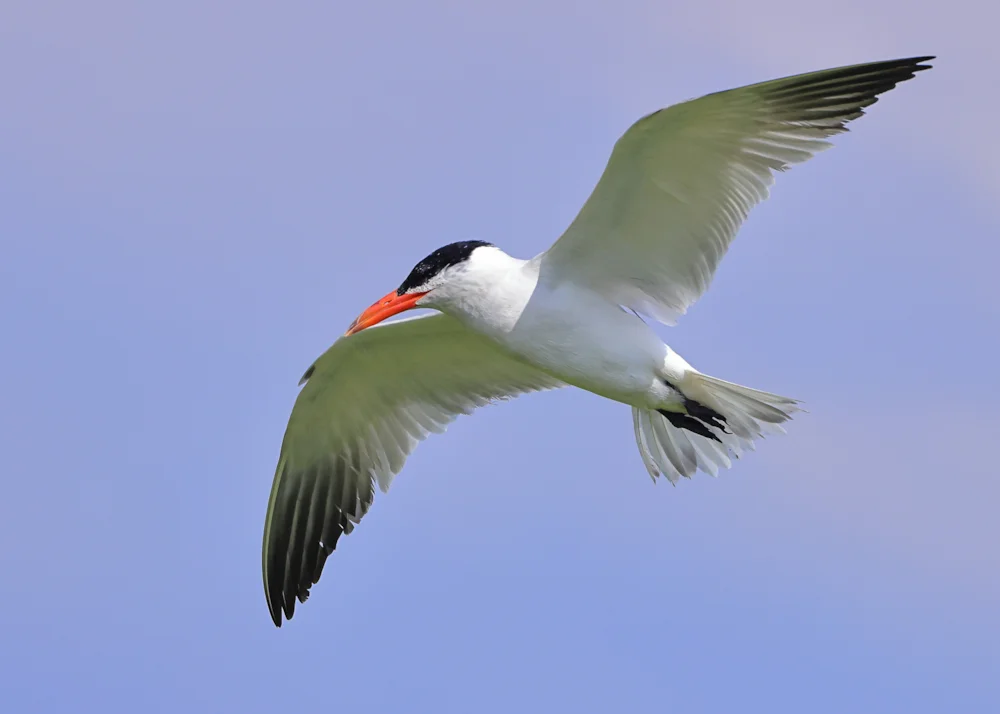
In flight, Caspian Tern can be recognised by its huge size, short tail, dark 'wedges' on the underside of the primaries and, of course, the massive red bill. Summer-plumaged birds possess a neat black cap, but this is variably speckled with white outside the breeding season (Mike Trew).
Observed trends
Caspian Tern has always been rare in Britain, but it had become increasingly so by the early years of the 21st century. A long-term average of five records per year had reduced to only three during the period 2000-2015.
A strong showing of 10 in 2016 – easily the best annual total of the 21st century to that point – signalled the start of an upturn. Although there was a rare blank year in 2018, the annual average increased to 6.4 for the period 2016-2022, with highs of 10 birds in 2020 and 16 in 2022. Furthermore, preliminary analysis of BirdGuides data for 2023 suggests that at least 16 Caspian Terns were seen that year.
Given the close proximity of the Baltic population, it has long been presumed to be the source of the majority of British records. This has been reinforced over the years through sightings of colour-ringed birds from both Sweden and Finland. With this in mind, it is worth focusing on the Baltic population when trying to explain the observed British trends.
There are two obvious hypotheses to explore when contemplating the upsurge in British Caspian Tern records in recent years. The first is that the Baltic population has increased. More pessimistically, it could perhaps be that an increased rate of breeding failure is leading to more wandering adults during the summer months.
Notably, the Swedish Caspian Tern population underwent a significant decline in the latter half of the 20th century, decreasing sharply from 1,000 pairs in the early 1970s to only 400 pairs in the mid-1990s, correlating with the arrival and establishment of non-native American Mink in the archipelagos where the terns bred. While there was a subsequent recovery to 600 pairs in 2007, the national population remained between 500 and 600 pairs until 2019.
In Finland, Caspian Tern has gradually increased over the past century and the population does not exhibit the strong fluctuations seen in Sweden. Only 200 pairs were estimated in the 1930s, with 1,000 pairs in the 1970s and 1,000-1,100 pairs in 2018. The most recent annual survey, in 2023, found 1,240 couples, but the population was estimated to be as high as 1,300 pairs. In Estonia, the latest estimate of 200-300 pairs in 2017 is considered stable after a long-term decline, while there is a small population of 22 pairs in Denmark.
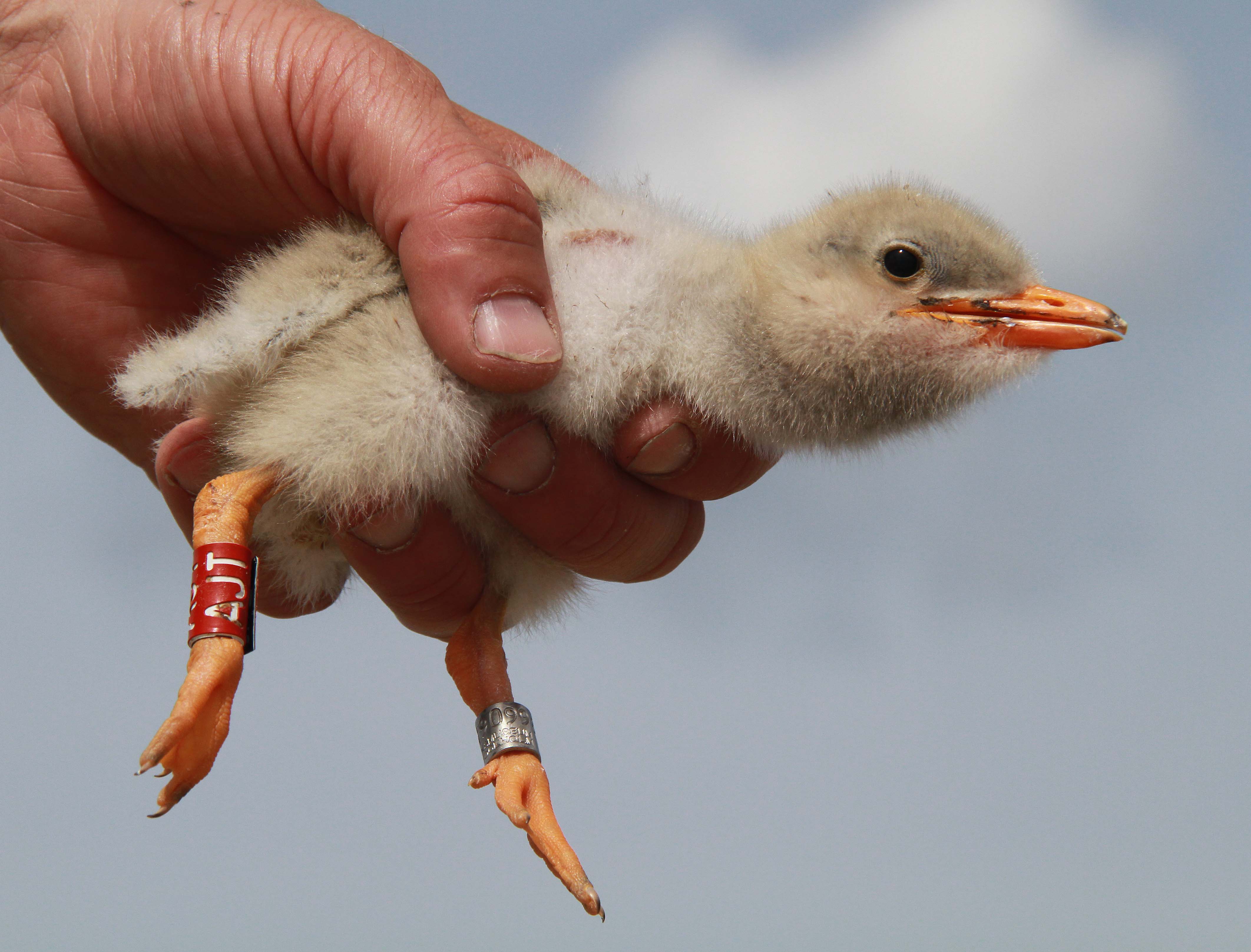
Caspian Tern is well studied in Sweden, where a good proportion of chicks are ringed every year. The introduction of coded darvic rings makes it easier to track individual birds (Ulrik Lötberg).
Conservation fightback
With mink ripping through seabird colonies in the Swedish islands, eradication became a necessity and has been carried out since 1997. This has largely been a success, with only one subsequent incidence of mink predation (in 2003). However, a more contemporary issue has also arisen: as well as European Herring and Great Black-backed Gulls taking tern chicks, the Baltic's burgeoning White-tailed Eagle population has become a significant problem for nesting Caspian Terns, with eagles opportunistically taking tern eggs.
Over the past decade, Swedish conservationists have worked hard to deter eagles from visiting the monitored colonies. One method involves mooring a boat just offshore with a scarecrow positioned in it. This seems to have been successful: from 2015 onwards, breeding productivity dramatically increased. After a low of 512 pairs in 2019, the nesting population has shown an impressive upward swing, with 634 pairs in 2020 increasing to 780 in 2021, then again to 840 pairs in 2023. The number of fledged young has also increased, with a record 811 chicks ringed in 2023.
Ulrik Lötberg, who leads BirdLife Sweden's Project Caspian Tern, explained: "We started to deter the eagles in 2014 and we saw good breeding success from 2015. Since it takes about five years for Caspian Tern to start breeding, we can see a clear connection in the timing with the work the project is doing and what is happening to the population.
"Although it is hard to deter the eagles, we have succeeded rather well and the tern population has increased by approximately 60% in 10 years, which makes us very happy."
Such intensive conservation measures are not carried out in other Baltic nations, but the ripple effect from the Swedish increase will be felt elsewhere. For example, Lötberg tells me that Swedish-ringed Caspian Terns have established new territories in Denmark, while there is also regular exchange in breeding birds between Swedish and Finnish colonies.
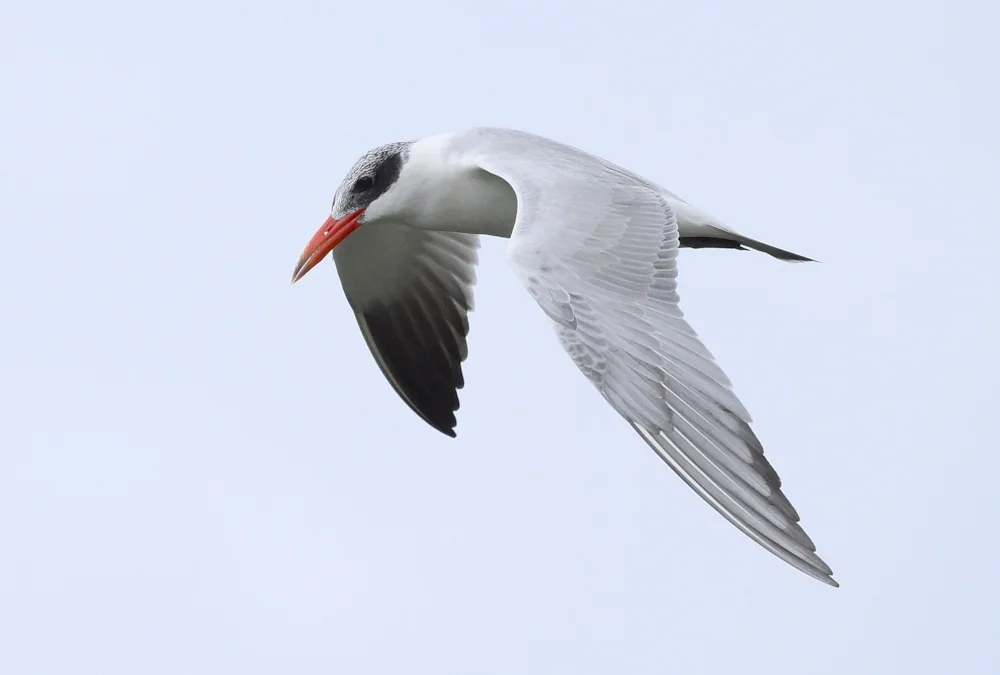
The majority of British Caspian Tern records are presumed to relate to birds originating from Swedish and Finnish colonies (Mick Colquhoun).
On the up
As things stand, the situation looks bright for Caspian Tern in Northern Europe. After many years of decline or flatlining, the Baltic population is increasing again – largely thanks to recent success in Sweden, but bolstered by a healthy Finnish population that is slowly growing. It is surely no coincidence that the pattern of occurrences in Britain mirrors this, with the upturn in records closely correlating with population recovery in Sweden, the westernmost-breeding birds.
Assuming that the positive trajectory continues in the Baltic, it seems likely that British records will show a similar trend. Of birds seen in Britain, Lötberg says: "I would guess that the Caspian Terns you get involve third- to fifth-calendar-year birds exploring as they look to establish new breeding areas."
With this in mind, Britain looks set for further prosperous years for Caspian Tern. Swedish birds raised in the highly productive breeding seasons of 2021-23 will begin to tour Europe in the next few years – this larger pool of birds could,
in theory, equate to even more records.
In the longer term, much will depend on the continuation of conservation methods such as predator control and whether novel threats do not come to light. Perhaps the most pertinent in the current climate is avian influenza, which has devastated seabird populations worldwide over the past few years. Mercifully, Baltic Caspian Tern colonies have so far been spared by the disease, despite shocking losses among several other tern species breeding in Northern Europe, as well as outbreaks on the birds' wintering grounds in West Africa. This seems all the more miraculous given that Caspian Tern colonies in the Great Lakes region of North America were ravaged by the virus in 2022.
Furthermore, given that Caspian Terns breed on low islands, often situating their nests only centimetres above sea level, colonies can be susceptible to the effects of stormy weather. Extreme weather events, including summer storms, are predicted to become more prevalent in Northern Europe as climate change intensifies and, coupled with sea-level rise, this could pose a significant problem in some areas.
Whatever the future holds for Caspian Tern in Europe, historical fluctuations inform us that there will be ups and downs. In the coming years at least, British birders should look to capitalise on the current upward trend and celebrate any encounter with this regal seabird on home shores – there may never be a better time to add it to your self-found or patch list.
Acknowledgements
Thanks to Ulrik Lötberg (BirdLife Sweden), Patrik Byholm and Antti Below (Finland), and Tarvo Valker (Estonia) for their input and help with this article.
- This article first appeared in the July 2024 edition of Birdwatch. To be the first to read the magazine each month, take out a subscription to Birdwatch, or get the magazine alongside your bird news by subscribing to either Bird News Ultimate (paper magazine) or Bird News Ultimate Plus (digital access).


