
It feels like no time ago that I was writing a similar article about what was, and may still be, the best seawatch ever at the Bridges of Ross, Co Clare. On 3 August 2024, several of Ireland's keenest birders logged a marathon 14-hour seawatch in ideal conditions at what could be argued as one of Europe's best seawatching locations. We were handsomely rewarded for our efforts with three Barolo Shearwaters, three Wilson's Storm Petrels and the first land-based record of South Polar Skua for Ireland.
The only seawatch in terms of rarities that comes close to this day from the Bridges of Ross was on the 25 August 1995, when Killian Mullarney and Kieran Fahy recorded a Barolo Shearwater, a Desertas-type petrel and a Wilson's Storm Petrel, the last being almost unheard of from land in Ireland at the time. This trio has never been repeated by anyone in a single seawatch since.
I felt it was likely I would never experience anything remotely as adrenaline-fuelled on an Irish seawatch again. How wrong I would be …
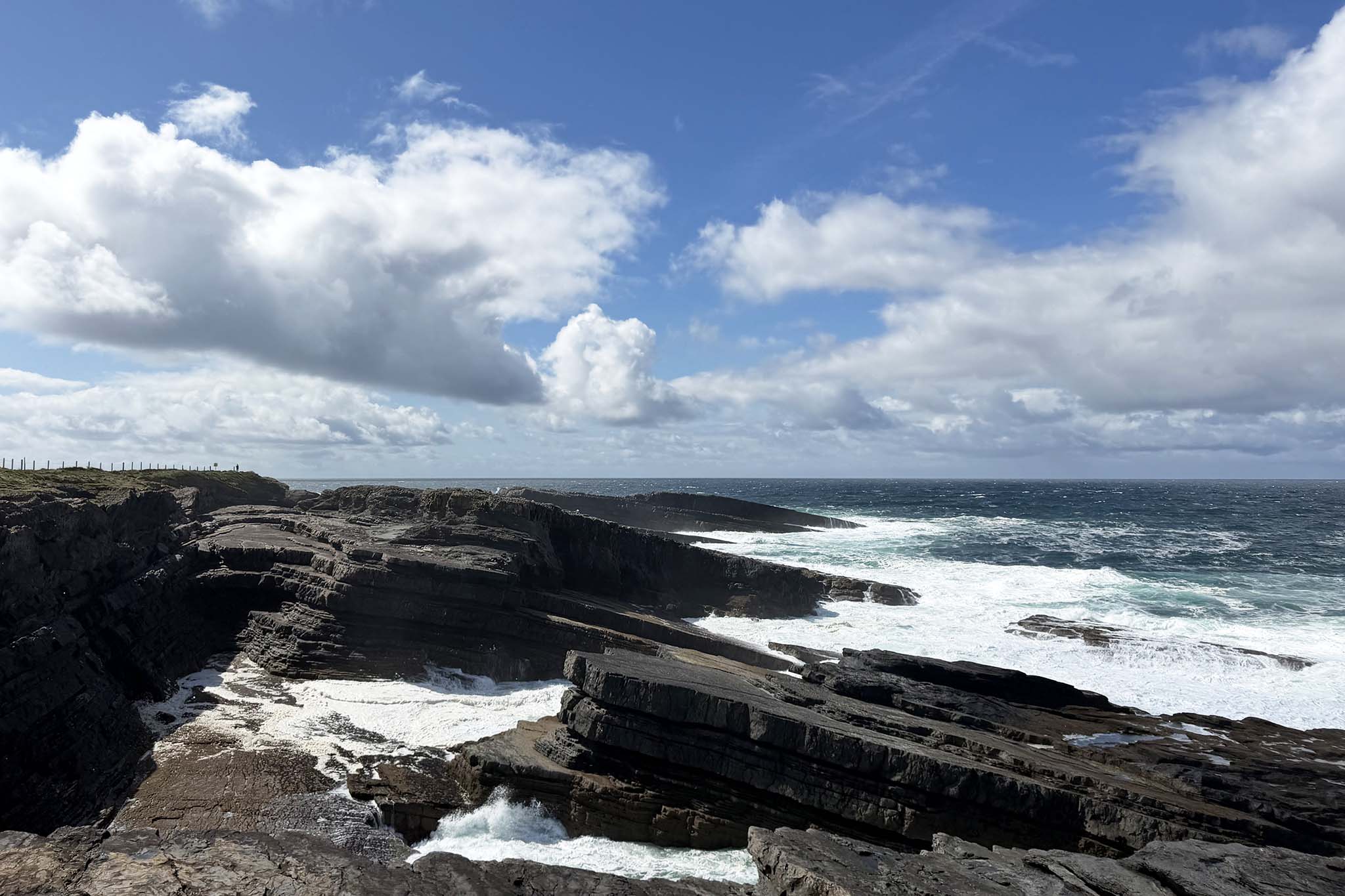
The Bridges of Ross is one of Europe's top seawatching destinations (Brian McCloskey).
Keeping an eye on the weather
I had been keeping a close eye on the winds throughout August and there were several instances when the long-range forecast looked incredible, only for it to fall apart two or three days out. I managed one seawatch in July, during which we logged 28 Wilson's Storm Petrels, but I was really champing at the bit for some August seawatching.
The two days of 18-19 August looked set to have decent conditions; not exceptional, but enough to suggest there would at least be birds to look at, particularly on Wednesday 19th. I was only able to get one day off work, so with an Force 5 westerly in the morning, swinging to an Force 6 north-westerly in the afternoon, I made plans to travel.
I was working in the Midlands on Tuesday. Once I finished up that evening, I made my way west on a slow, arduous drive, during which I seemed to be constantly behind some of the slowest drivers in the country. I arrived in Kilbaha just before 8 pm and grabbed a bite to eat with a few birding friends who had the same idea.
Tallies from two very impressive seawatches from the south-west came through that evening. A seawatch from the Bridges of Ross produced a Scopoli's Shearwater at close range, found by Peter Phillips, and a watch from Brandon Point, Co Kerry, by Eric Dempsey and Mick O'Clery was phenomenal, with both a Scopoli's Shearwater and a South Polar Skua recorded! Hopes were high for the following morning. I find that there are few things more exciting than arriving in Kilbaha the evening before a seawatch, with the wind blowing from the west.
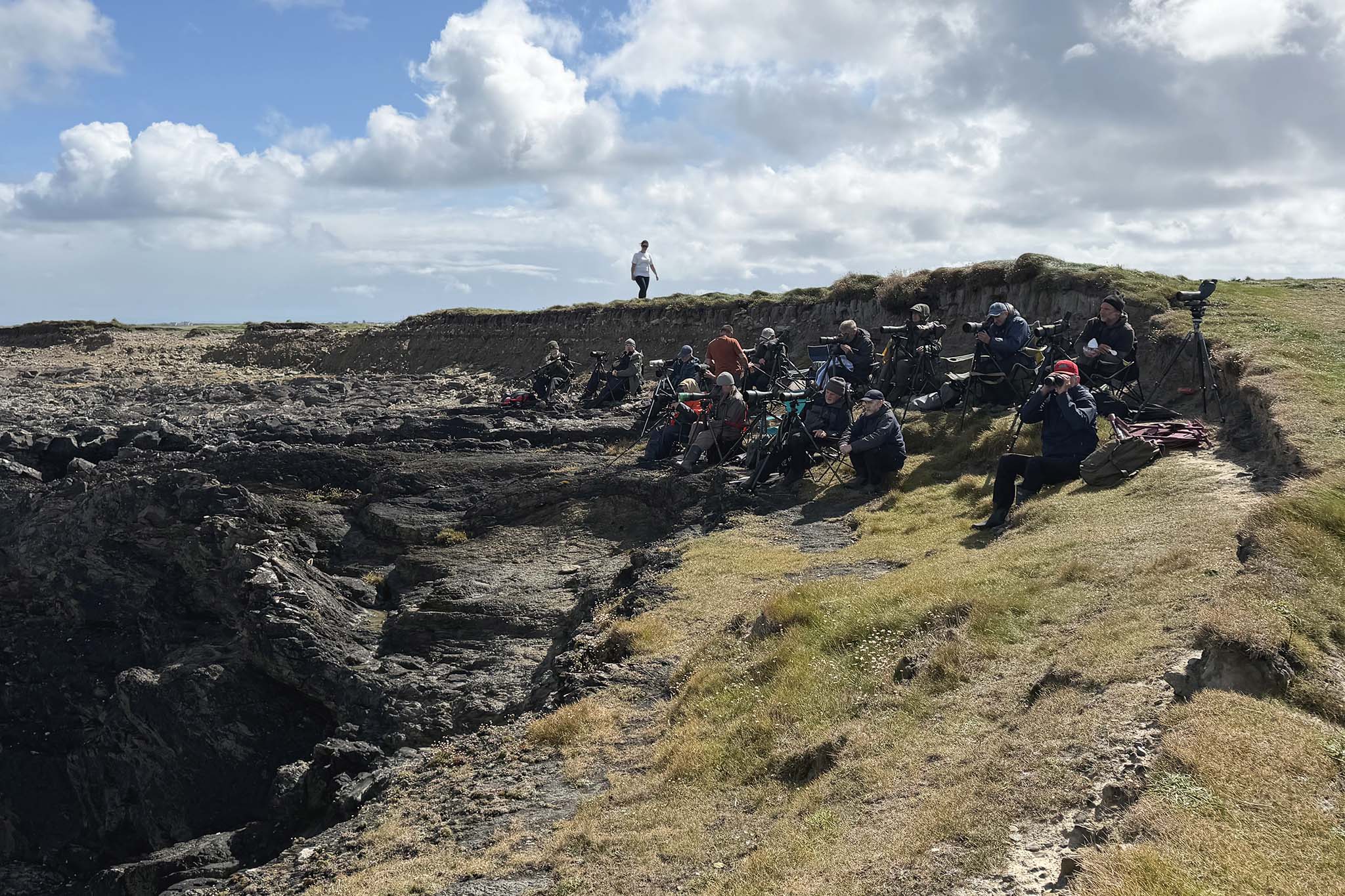
Seawatchers gathered in 'The Hollow' at Bridges of Ross, 19 August 2026 (Brian McCloskey).
Early alarms
Brian Porter, Cian Cardiff and I set our alarms for a ridiculous hour to secure the 'good seats' at the Bridges. By 5.40 am, when we arrived in the car park, birders were already walking out to the cliffs. Ten minutes later, we were all scanning the seas. I managed to squeeze my chair into my preferred spot at the top of 'The Hollow'. I had Cian Cardiff to my right and Killian Mullarney and Brian Porter to my left.
I started clicking Cory's Shearwaters, which, after a bit of a slow start, began to pile through. Gradually, more and more birders arrived in The Hollow, and throughout the day, 20 seawatchers had amassed.
I kept a very close eye on every Cory's that I clicked until I eventually found what looked like a perfect Scopoli's Shearwater. I called it out and followed it just off the point, but unfortunately nobody else managed to get a conclusive view before it disappeared behind the grass. I jumped up onto the bank, but I failed to pick it up again. This was gutting, as it looked really good, but I just had to let it go, as I didn't manage any shots.
For the past four or so years, I have double-checked every Great Skua that has been called off the Bridges. That is why I have already managed to see South Polar Skua in Ireland. Throughout the morning, we had several Great Skuas fly past close in, often in twos or threes. At 8.25 am, I heard the call of "two Bonxies over the slabs". I quickly got onto them and was happy that they were both adult-type Great Skuas. I was totally oblivious to a third bird passing at the same time, let alone an interesting-looking one.
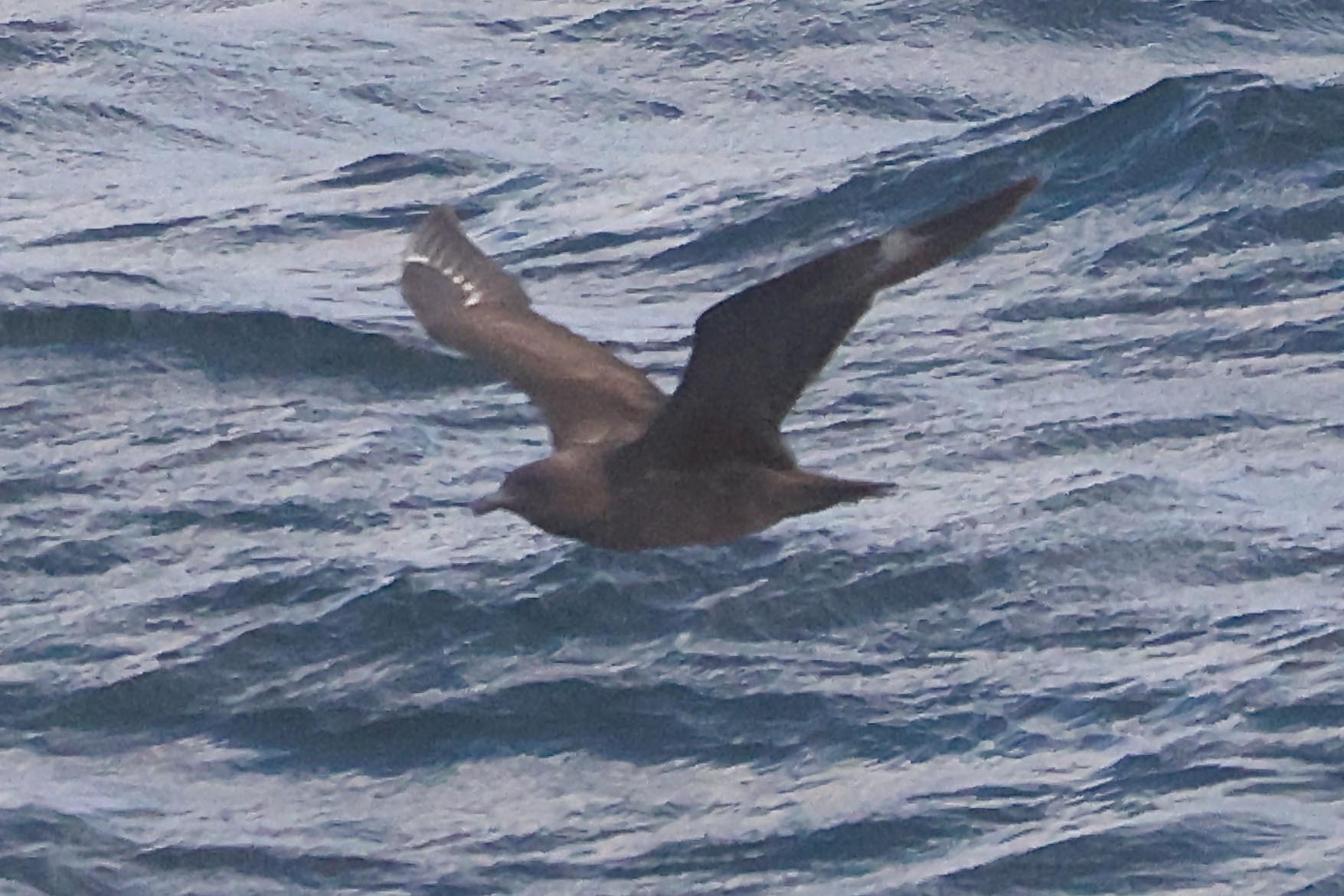
The first South Polar Skua to pass on the morning of 19 August 2026 (Aidan Kelly).
Flagging the third bird
As it turned out, Aidan Kelly, who was at the other end of the crowd from me, had flagged the third bird as looking very interesting. Aidan and Sean Holland managed to get great shots that nailed it as a South Polar Skua. It was a great pickup by Aidan, but totally gutting for me! Of all the seawatchers present, only Brian, Killian and I hadn't seen it. I hate missing rare seabirds. Up to this point, I had clicked something like 770 Cory's Shearwaters, but I lost all interest in the seawatch and it took about an hour for me to start scanning properly again.
At 10.14 am, I heard "three Bonxies over the slabs". Within seconds, I had picked up four large skuas flying towards us at close range. The first two birds were definitely adult-type Great Skuas, and then I had a proper look at the third skua. When I saw it, I thought my heart was going to leap out of my chest. For the next five or so seconds, I watched it and was totally convinced that this was a South Polar Skua. It was so uniform and the head was concolourous with the body, with no suggestion of a cap or hood.
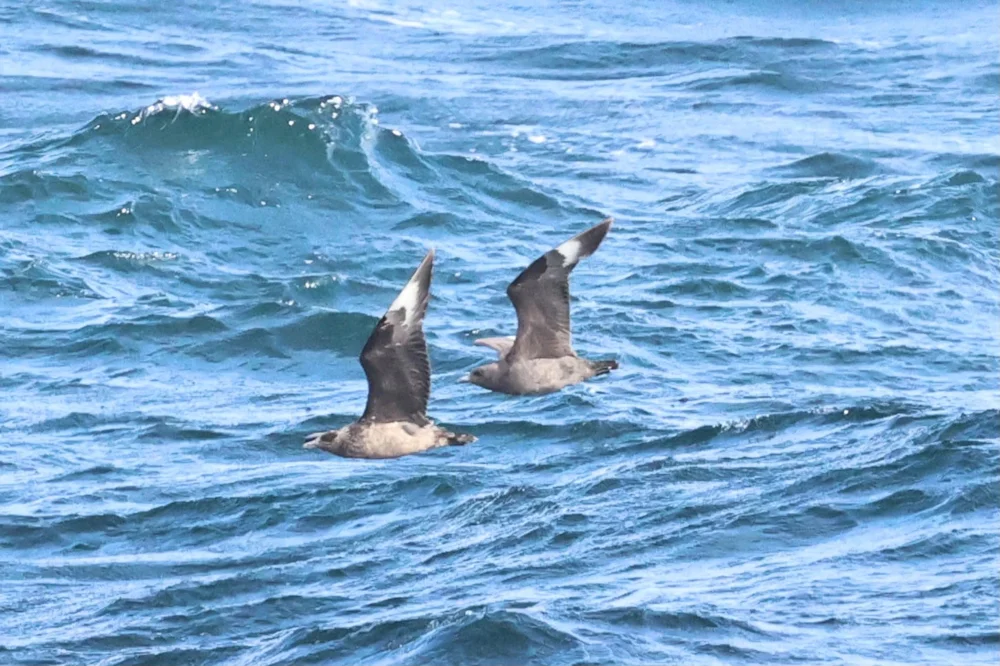
South Polar Skua (right) with Great Skua, Bridges of Ross, Clare, 19 August 2026. The second individual of the morning (Cian Cardiff).
I took a deep breath and called out – "everyone, get on this skua!" I can't remember exactly what else I said, but I was in a panic and the adrenaline was pumping. The more I watched it, the more certain I was that it was a South Polar Skua. Killian, who was sitting to my left, asked me to keep shouting directions. It had now joined one of the Great Skuas, and Killian was looking through the viewfinder at it.
I roared down to Aidan, who already had his camera up, to get shots of the bird. It turned out he was trying to take close-up Bonxie shots to compare them with the earlier South Polar Skua. He quickly moved onto the South Polar and blasted away, managing to get some shots before and after it passed the point. I didn't realise at the time, but Cian, on my right, had absolutely nailed the shots as it flew past heading west. Before I knew it, the bird had passed under the point and disappeared. With panic in my voice, I asked Killian if I could see the shots, and he turned to me and calmly said, "It was a South Polar."
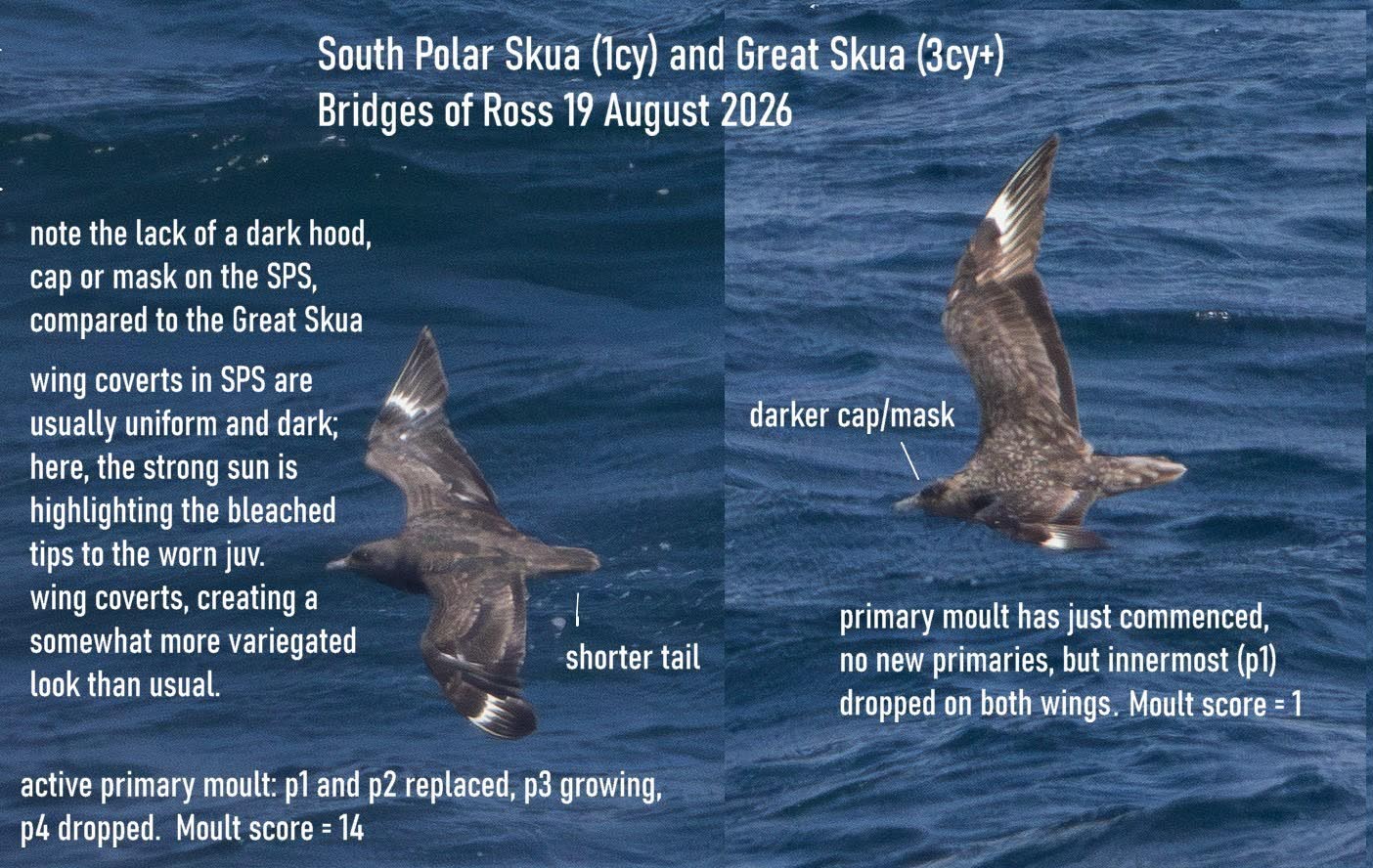
Analysis of the second South Polar Skua (left) and an accompanying Great Skua (Killian Mullarney).
South Polar success
I was completely ecstatic, and the atmosphere in The Hollow was unbelievable. This was a new Irish bird for Killian and Brian Porter, as they hadn't seen the first one; however, I reckon most birders present were a bit relieved to see this one properly! The shots the lads managed were incredible, so much so that it is difficult to comprehend they were taken from land. Without the superb images, it might have just been another bird that had to be let go; thankfully, this wasn't the case.
Further analysis confirmed that the bird was a first-cycle and a moult score of 14 places it well within the range of South Polar Skua and outside the range of Great Skua. In the field, I could see that something was going on with the upperparts and I suspected that it was a new generation of feathers. The patchiness on the upperparts turned out to be moulted median coverts and inner primaries, which made the upperparts look a bit contrasting. The upperparts on a typical South Polar Skua are often totally uniform.
Needless to say, every Bonxie for the rest of the day was grilled to within an inch of its life, but we had no more that even raised a pulse. The rest of the seawatch was still fairly eventful, with nine Wilson's Storm Petrels, one of which hung around just offshore for ages, two adult Sabine's Gulls, and a Grey Phalarope.
Then, at 3.30 pm, Aidan Kelly roared out "Fea's-type off the Point". Within seconds, I was on it. I quickly switched to video, but struggled with the glare on the screen. I managed to get some poor footage, though the stills were usable. I watched it for a minute or two before jumping up onto the bank, where I picked it up again, but it was now difficult to follow. It passed under a distant tanker on the horizon, and Paul Moore saw it a short time later. This was a tick for John Cusack, whom I was delighted for, as he had previously missed one on a seawatch.
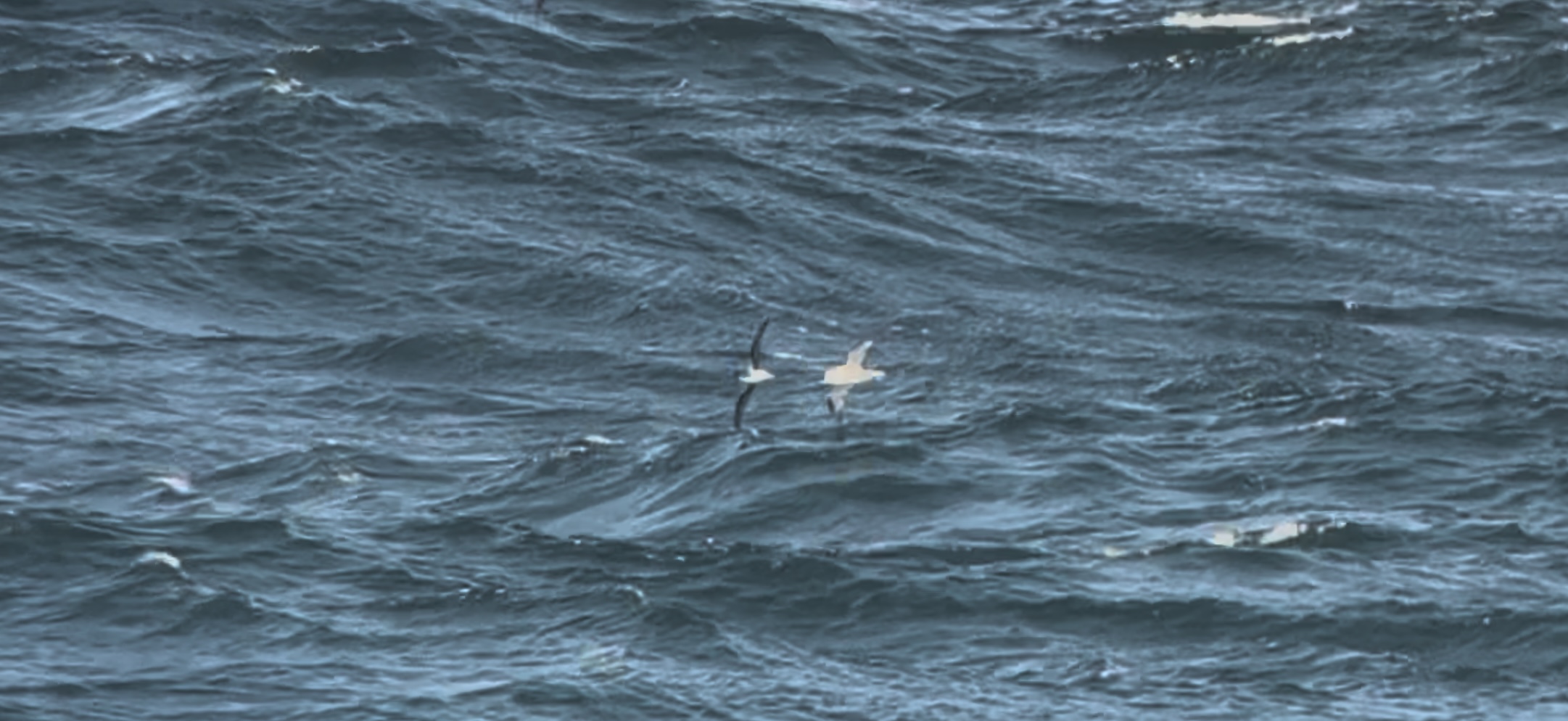
The first Fea's-type Petrel (left bird) to pass the Bridges on 19 August 2026 (Brian McCloskey).
A second Fea's
Quite a few failed to pick up this Fea's, so for many it was a real relief when, less than 20 minutes later, at 3.57 pm, Paul Moore shouted out "Fea's Petrel behind the slabs". This bird would take ages to pass, as it hadn't even entered the bay! Cian, who had missed the first one, was the first to pick this one up after Paul. Seconds later, I was on it. Initially distant, it gradually got closer to land before eventually passing just behind the nearest Manx Shearwater line. To me, this was clearly a Desertas/Fea's-type rather than a Zino's-type.
Again, we jumped up onto the bank and I was on it straight away. I tried to give Brian Porter a view in my 'scope; however, when he looked through, nothing flew through! I failed to pick it up again. It took over five minutes to pass. I don't think any of us could believe what was happening!
As the evening wore on, most people started to leave. I probably would have stayed there all night, but the last four of us, Killian, Aidan, Victor Caschera and I, decided to call it quits at 7.15 pm, more than 13 hours after we started.
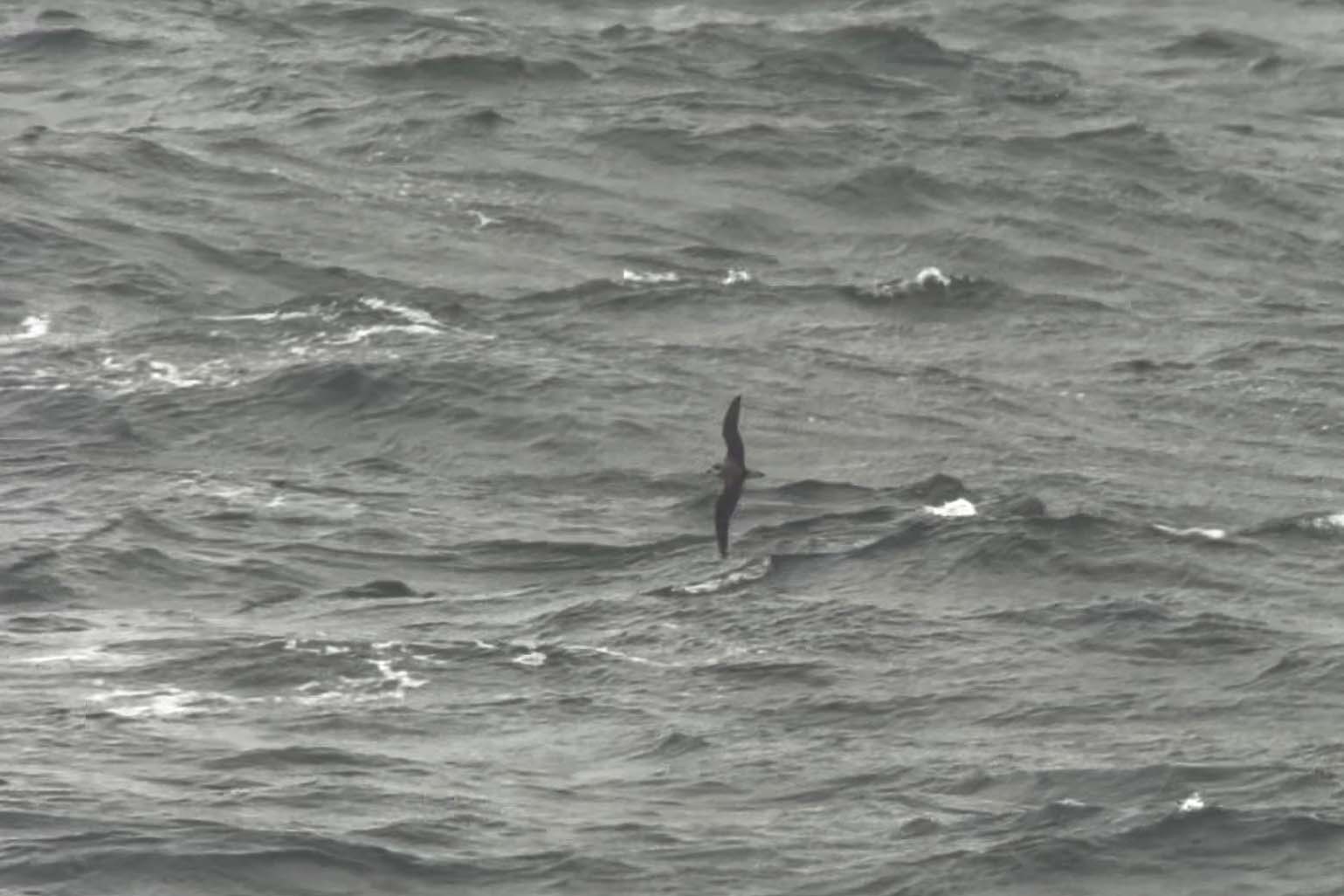
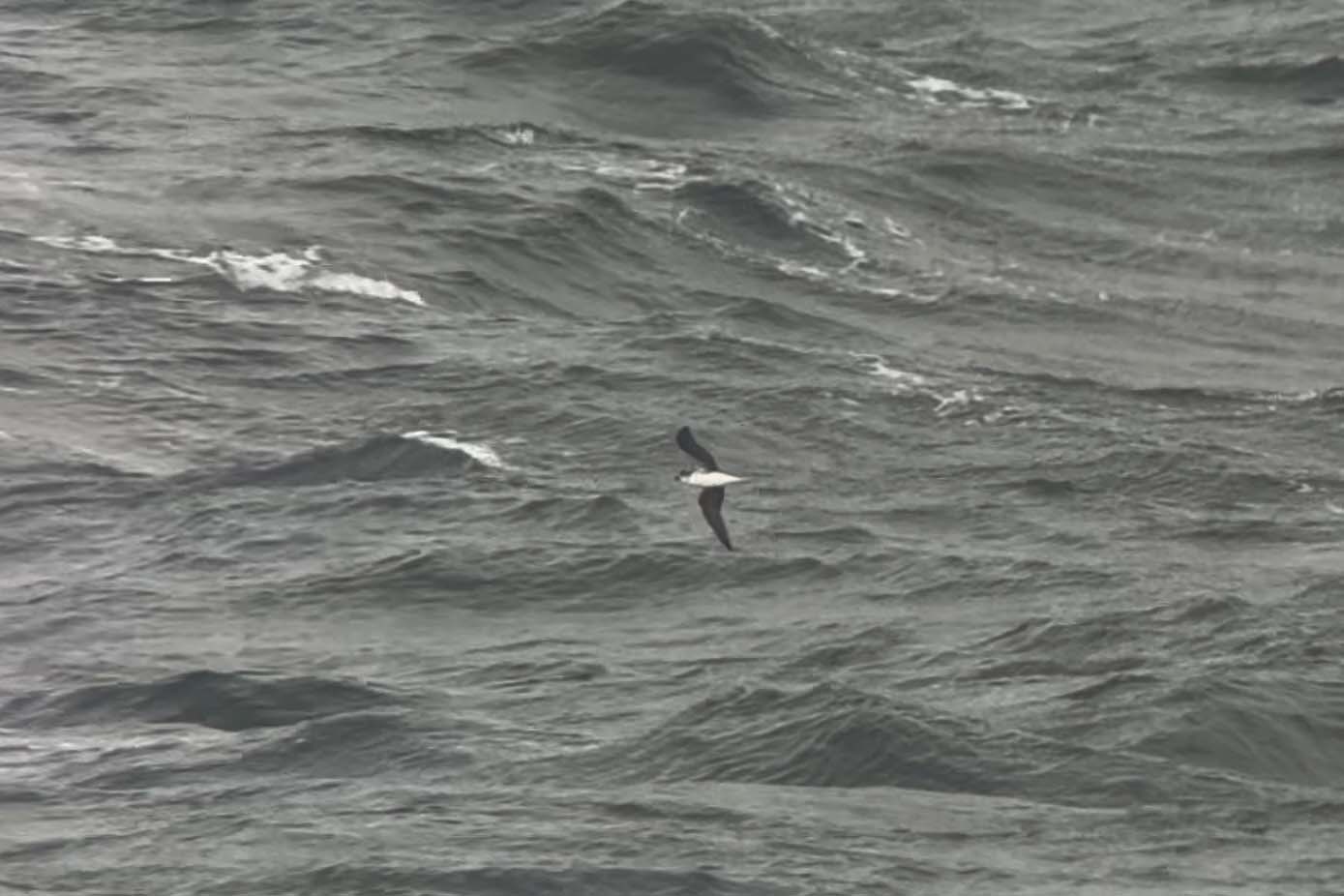
The second Fea's-type Petrel to pass the Bridges on 19 August 2026 (Brian McCloskey).

