
A new study has tracked female Eurasian Dotterel throughout an entire summer for the first time, revealing a summer of long-distance travel in search of multiple partners.
The research found that in the bid to breed successfully, female dotterel will visit an average of three sites per summer, these being situated up to 1,000 km apart.
This in turn suggests that dotterel populations may be more connected than was previously thought.
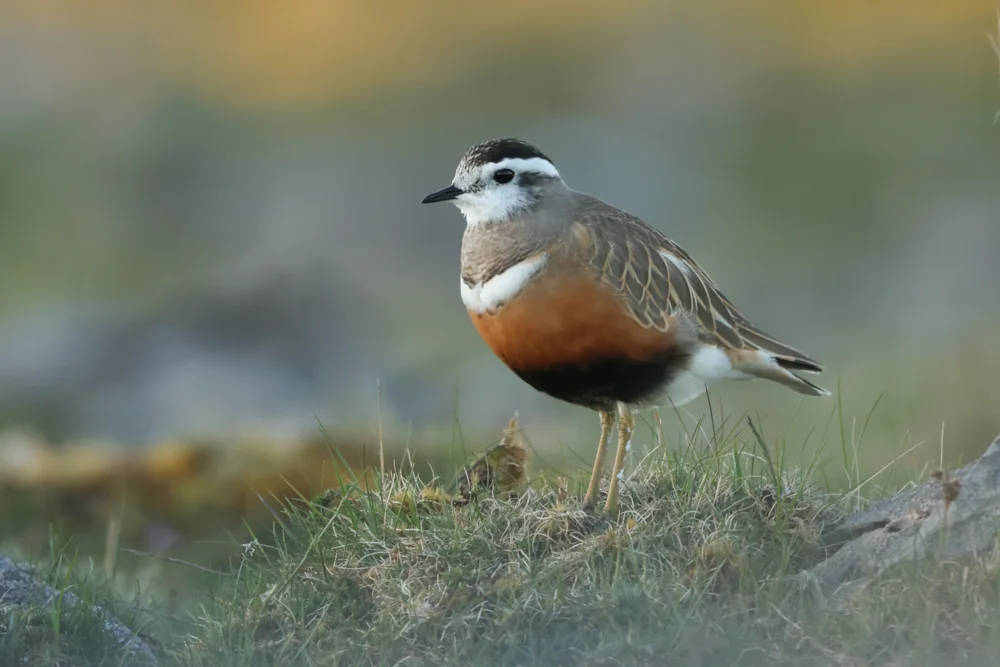
Female Eurasian Dotterel travel thousands of kilometres each summer in search of multiple partners (Tate Lloyd).
Female of the species
Eurasian Dotterel is a polyandrous species, meaning that females will partner with multiple males. Females are bigger and brighter than males, and take the active role in courtship. Females display and compete with other females to secure a mate, but once a female has laid her clutch of three eggs, she typically leaves the male who then incubates the eggs and raises the chicks alone.
Where female dotterel go next has long been considered a mystery. Field observations have shown that most females leave the breeding site shortly after laying eggs. It seems too early for the return migration to their North African wintering grounds, so ornithologists have long suspected the females head elsewhere in search of further mating opportunities. However, no dotterel had ever been followed to confirm this theory.
Tagging reveals answers
In a recent study, Bart Kempenaers and his colleagues attached satellite tags to 21 female Eurasian Dotterel in southern Norway and at migration stop-over sites in the Italian Alps over a three-year period.
This revealed that during the seven-week window when female dotterel typically lay their clutches, individual females settled at between one and five different sites, with a median of three. Consecutive sites were typically less than 100 km apart, but one female travelled 973 km between two stays, and the most wide-ranging bird covered 1,343 km in total.
Early on, females travelled mostly northward, possibly tracking the retreating snow line as new breeding habitat opened up. Later in the season, the northward pattern faded and movements became shorter, as females may have searched more locally for males whose earlier nesting attempts had failed.
Their journeys were more modest than those documented in males of polygynous species, such as Ruff and Pectoral Sandpiper. This, the researchers say, reflects the greater investment required by females: males need only a single copulation to reproduce at a site, whereas females must form a short-term pair bond and lay a full clutch.
Further questions remain
Intriguingly, females lingered at their final site for a median of 41 days – far longer than the brief stays at earlier sites. Two females also returned to a site they had already left, one after 20 days and having travelled 382 km away.
Previous studies have shown that female incubation occurs at some dotterel nests and is most common late in the season and at the northern edge of the range. These observations suggest that some of the long final stays may be females switching, at last, to care for a clutch. However, behaviours like these are hard to interpret from satellite data alone.
Bart Kempenaers said: "Local populations of dotterels may in fact be connected in ways we have so far missed, with the same females moving between distant sites. The movements and breeding behaviour of these beautiful birds illustrate how the world is connected: their annual cycle stretches from the highlands and tundra of Northern Europe and Russia to the semi-deserts of North Africa.
"Combining tracking with fieldwork at breeding sites is the next step to figure out what these movements mean for the evolution of mating systems. We also need to tag more birds in different regions to better understand how their populations are connected. What we have learnt is that even well-studied birds can still surprise us."
Reference
Kempenaers, B, Santema, P, Cragnolini, N, Eberhart-Hertel, L, Krietsch, J, Kwon, E, and Lislevand, T. 2026. Females of a socially polyandrous, sex-role reversed shorebird visit multiple breeding sites within a single season. Proceedings of the Royal Society B. DOI: https://doi.org/10.1098/rspb.2026.1110

