
Satellite tracking has revealed the remarkable migration journeys of Booted and Steppe Eagles along one of the world's least studied major flyways.
The research, published in Zoology in the Middle East, tracked two individual raptors fitted with GPS-GSM transmitters at Aras River Ornithological Station in north-eastern Türkiye.
The Booted Eagle completed an autumn journey of 5,081 km in 49 days, travelling through the Middle East to winter at Mount Elgon in Uganda. In spring it largely retraced its route, covering a further 6,786 km over 35 days to reach breeding grounds in Russia.
The study represents the first satellite-tracking investigation of Booted Eagle migration along this flyway.
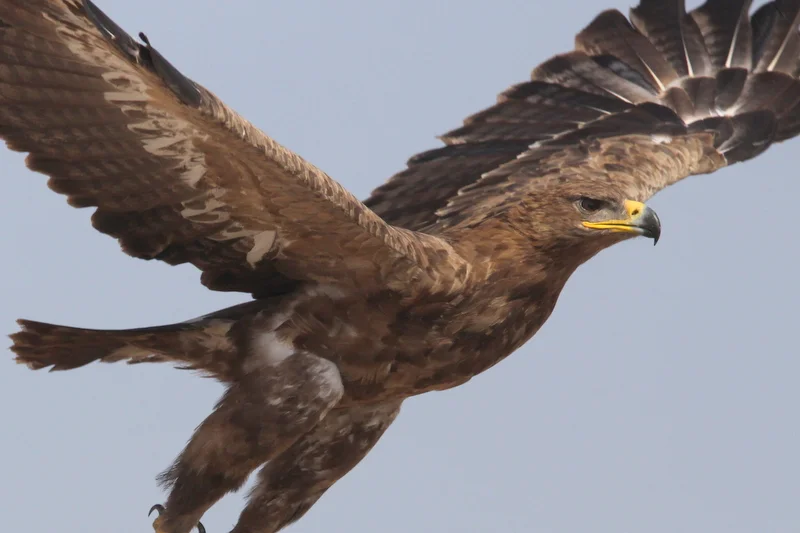
GPS tracking has provided a glimpse of the migration routes of Steppe Eagles along the poorly understood East Asia-East Africa Flyway (Kris Webb).
Steppe route
The Steppe Eagle followed a different route. During its autumn migration, the bird travelled 4,410 km over 38 days before reaching wintering grounds in Sudan. Rather than following the species' more typical route via the Bab el-Mandeb Strait, it travelled through the Suez Canal region.
Its transmitter subsequently stopped providing data, leaving its fate unknown.
The East Asia-East Africa Flyway stretches from breeding grounds in Siberia and eastern Russia to wintering areas in eastern and southern Africa, crossing more than 60 countries. Raptors using the route face a range of threats, including persecution, falconry, habitat loss, pesticide use and collisions with power infrastructure.
Importance of identifying and protecting migration bottlenecks
The GPS data also revealed that the eagles used heavily modified landscapes during their journeys, including agricultural areas, urban environments and rubbish dumps.
The researchers warn, however, that the study is based on only two individuals, so these movements cannot be assumed to represent typical behaviour for either species.
Nevertheless, the detailed tracks highlight the importance of identifying and protecting migration bottlenecks and stop-over areas along the flyway, particularly where birds face increasing pressure from human activity.
Reference
Murthy, N, et al. 2026. Where eagles dare: tracking data reveals migratory pathways of booted and steppe eagles in the East Asia-East Africa Flyway. Zoology in the Middle East. DOI: 10.1080/09397140.2026.2700089


