
European Nightjar's wings appear to balance the demands of catching insects at low speeds with those of long-distance migration, according to new research from Lund University.
The nocturnal migrant travels between Europe and Southern Africa, but must also manoeuvre sharply and fly slowly while hunting. To investigate how its wings accommodate these different tasks, researchers studied nightjars in a wind tunnel, measuring airflow behind the birds as they flew at different speeds.
The results, published in PLOS Biology, indicate that the species' broad wing-tips are likely to help with slow flight, but come at a cost: as speed increases, lift production becomes less efficient. The findings challenge the idea that long-distance migrants are necessarily optimised for efficient cruising above all else.
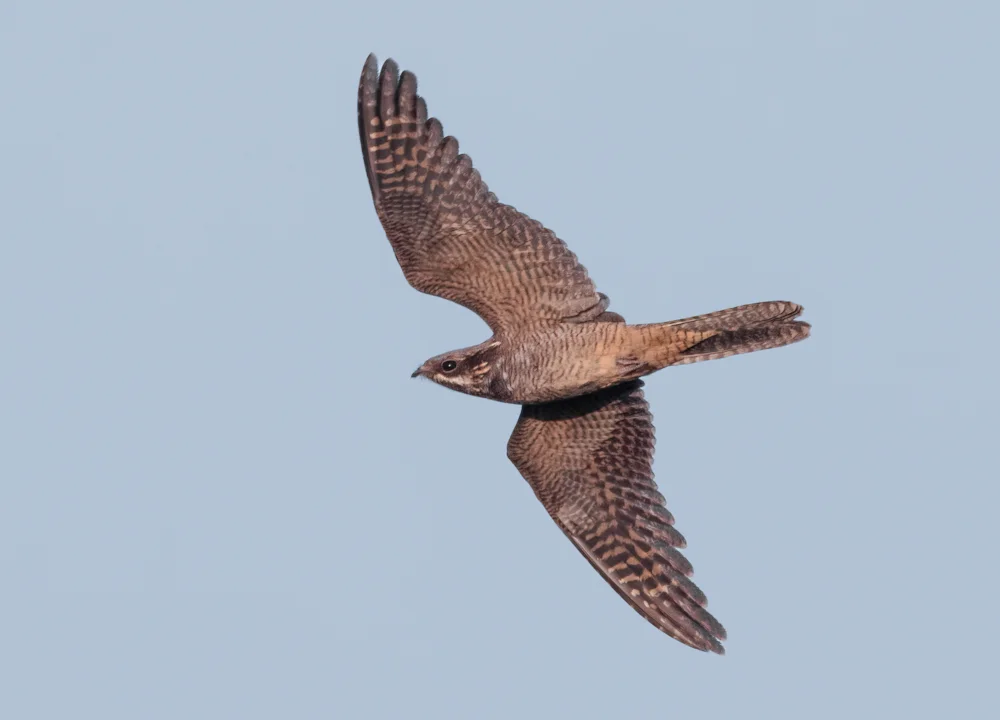
Wind-tunnel experiments show how European Nightjar's broad wingtips aid slow, manoeuvrable flight but reduce the efficiency of lift production at higher speeds (Alex Penn).
Flight producing force
Researchers describe the wings as a compromise between migration, foraging and manoeuvrability, rather than an adaptation for one particular flight style.
The study also uncovered an unexpected feature of nightjar's wingbeat. The birds generated thrust during the upstroke, when the wings move upwards. Active thrust production during this phase has more commonly been associated with bats and insects than with birds.
The researchers suggest that nightjar's ability to generate thrust on the upstroke may be linked to restrictions on how far its wings can fold during each beat. Understanding this mechanism could help establish how different flying animals produce force.
Aerodynamic strategy
The findings may also have implications for the design of flapping-wing aircraft and drones, whose wings face similar constraints. The researchers now want to investigate whether this aerodynamic strategy occurs in other birds and flying animals, and which aspects are distinctive to nightjars.
The work highlights how evolution can shape flight through competing demands: a wing that supports slow, precise hunting may not deliver the same efficiency at higher speeds. For nightjars, the result appears to be an effective, if imperfect, solution to the varied challenges of life on the wing.
Reference
Johansson, C L, et al. 2026. Nightjars trade off cruising speed efficiency for hovering capabilities and link upstroke thrust production with restricted wing folding. PLOS Biology. DOI: 10.1371/journal.pbio.3004023

