
A major new study has now shown that, for Pied Flycatchers, both genetics and upbringing help determine where they spend the non-breeding season.
Researchers tracked birds from eight breeding populations spanning Spain to western Siberia using miniature dataloggers. Despite breeding thousands of kilometres apart, all populations followed a remarkably similar initial route, travelling south-west through Iberia before making a non-stop Saharan crossing of some 40 hours to West Africa.
Once in Africa, however, the populations diverged. Spanish birds wintered furthest west, while Siberian birds continued eastwards as far as Nigeria. The latter completed migrations approaching 13,000 km, despite a more direct Mediterranean route being available.
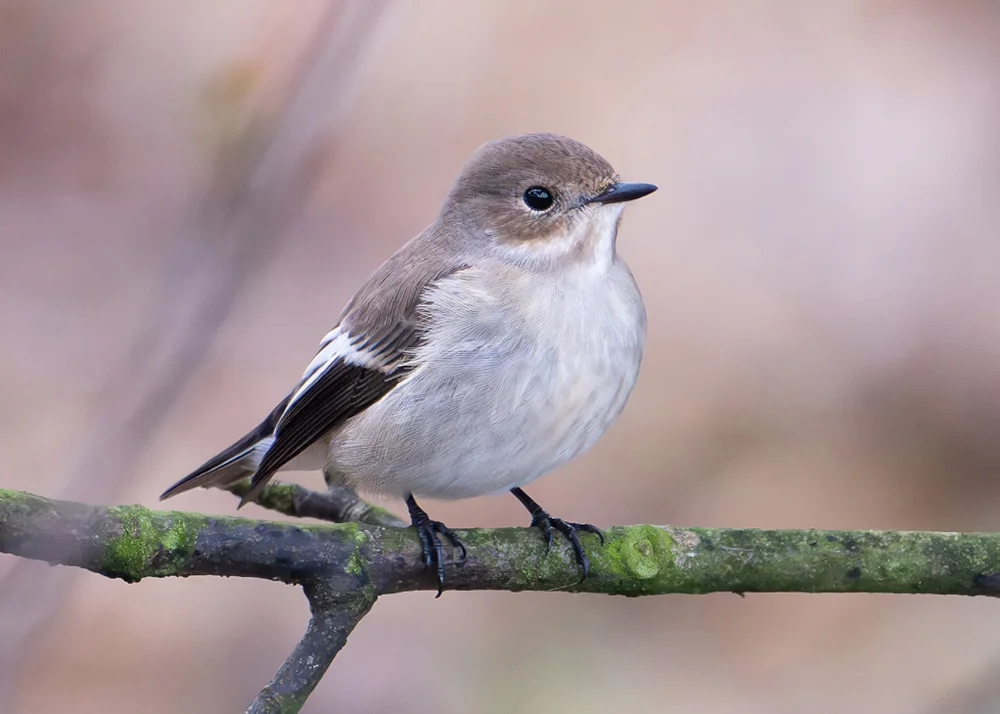
A new study has revealed that Pied Flycatchers inherit part of their migration programme, but their early environment also influences where they spend the winter in Africa (Ian Curran).
Evolutionary legacy
Lead author Koosje Lamers suggested the detour may be an evolutionary legacy dating back to the last glacial maximum, when the species occupied a much smaller range in Western Europe and Africa.
To investigate whether migration routes are inherited or learned, the researchers carried out an unusual foster experiment. Eggs laid by Dutch Pied Flycatchers were transferred to nests in southern Sweden, where they were raised by Swedish adults. Other broods contained mixed Dutch-Swedish parentage.
When tracked to Africa, Dutch birds reared in Sweden wintered roughly halfway between the normal Dutch and Swedish wintering areas, while birds with mixed ancestry settled slightly closer to the Swedish population.
Different influences
The findings, published in Science, suggest that migration is neither entirely genetic nor entirely shaped by the environment. Instead, both influence where birds ultimately spend the winter, while the broad migration corridor remains largely shared between populations.
Understanding this balance could prove important as migratory species respond to climate change, allowing new combinations of breeding and wintering areas to emerge over time.
Reference
Lamers, K P, et al. 2026. Translocation reveals that genes and ontogeny determine nonbreeding areas of migrant songbirds. Science. DOI: 10.1126/science.ads0532

