
The loss of family groups during winter can have serious consequences for young Bewick's Swans, with orphaned birds migrating later in spring and suffering substantially lower survival, new research has found.
The study, published in Behavioral Ecology and Sociobiology, used GPS transmitters and DNA analysis to examine the movements and family relationships of 55 Bewick's Swans from 12 complete family groups.
Bewick's Swans breed on the Arctic tundra of European Russia before migrating south to winter in the Netherlands and surrounding countries. Families normally remain together until at least halfway through the first spring migration, when young birds are approaching one year old.
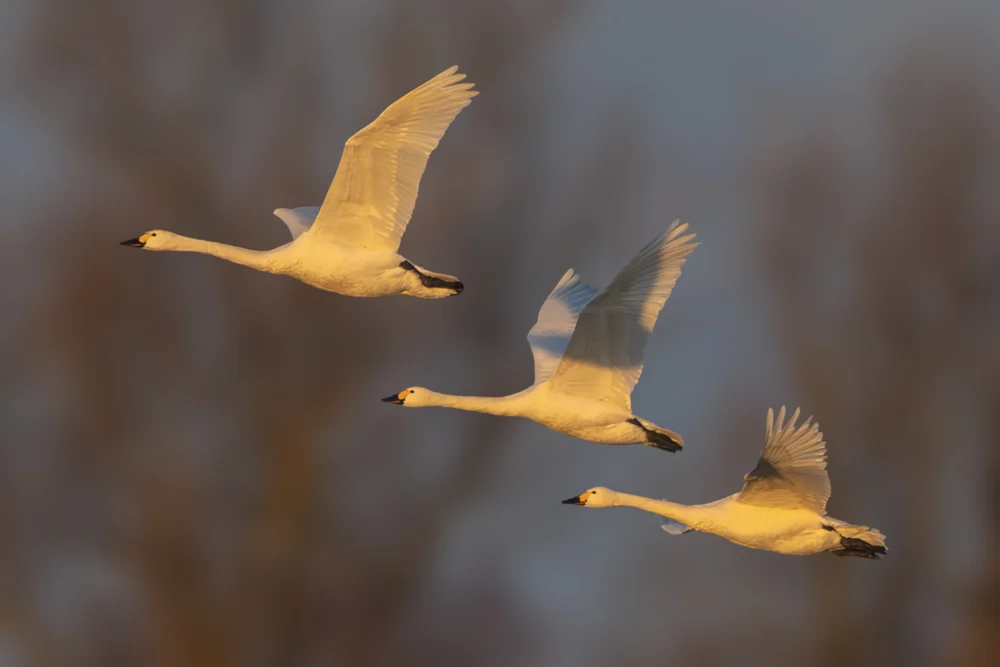
Young Bewick's Swans that lose their parents during winter migrate a month later and have markedly lower survival, according to a study (Will Bowell).
Orphaned juveniles face migration struggles
However, 10 of the 24 juveniles in the study lost their parents during the winter. Most cases followed disturbance at roosting and feeding sites, including incursions by hunters into an important protected nature reserve.
The consequences were striking. Orphaned juveniles began their spring migration almost a month later than young that remained with their parents. Their subsequent survival rate was only 40%, compared with 86% among juveniles that remained with their family.
GPS data showed one orphaned bird travelling north considerably behind other swans, while several others subsequently disappeared from the tracking network and were presumed not to have survived.
Some success stories
One bird provided a more positive example. After its mother was shot, the juvenile travelled to Britain and joined another family before eventually beginning its migration independently. It later reunited with its biological father in the Russian Arctic and survived to at least five years of age.
The findings are particularly significant given the long-term decline of the north-west European Bewick's Swan population.
The researchers conclude that conservation measures need to protect not only important wintering and feeding areas, but also the social conditions that allow young birds to remain with experienced adults during their first migration.
Minimising disturbance during winter and early spring could therefore have direct consequences for juvenile survival.
Reference
Linssen, H, et al. 2026. Family life is critical for migration and survival in a long-lived social bird. Behavioral Ecology and Sociobiology. DOI: 10.1007/s00265-026-03787-5

