
A few months ago, I bought my own house. After three years living in a quaint 1901 cottage, complete with extortionate rent, a rickety staircase and the odd patch of mould, I now have a corner of the world to call my own, and our new garden is already showing wild potential. We arrived to find compost bins, water butts, huge growths of honeysuckle covering the fence and shed, trees and bushes, bird and bat boxes, a hedgehog house and a pond (which we're making bigger). I now also own solar panels – hurrah! What's more, we abut a respectable patch of scrub, probably covering a football pitch or two in total, with a glorious thick hedge and huge trees – it's earmarked for development, but this hasn't happened yet.
As such, the bird list has started well, particularly with breeding species. Since March, we've recorded one Dunnock nest, at least three House Sparrow nests, two territorial male Blackbirds with females seen carrying food, a family of European Robins, likely nesting Great Tit and a Eurasian Wren brood.
Include the scrub and we add Blackcap, two Common Whitethroat nests, Common Buzzard, Jackdaw, Common Starling, duetting Tawny Owls and a noisy family of Great Spotted Woodpeckers. In the field beyond, there are displaying Eurasian Skylarks and Northern Lapwings, and James picked out a singing Lesser Whitethroat. A Eurasian Bullfinch put in a brief appearance, along with Coal Tit and Common Linnet.
When you notice the families that choose your garden, you find yourself somewhat invested. Towards the end of May, James and I were in the garden one sunny evening. The wrens had been hard at work feeding young, the nest being next to the bathroom window (it's a bat box with a thin opening at the bottom).
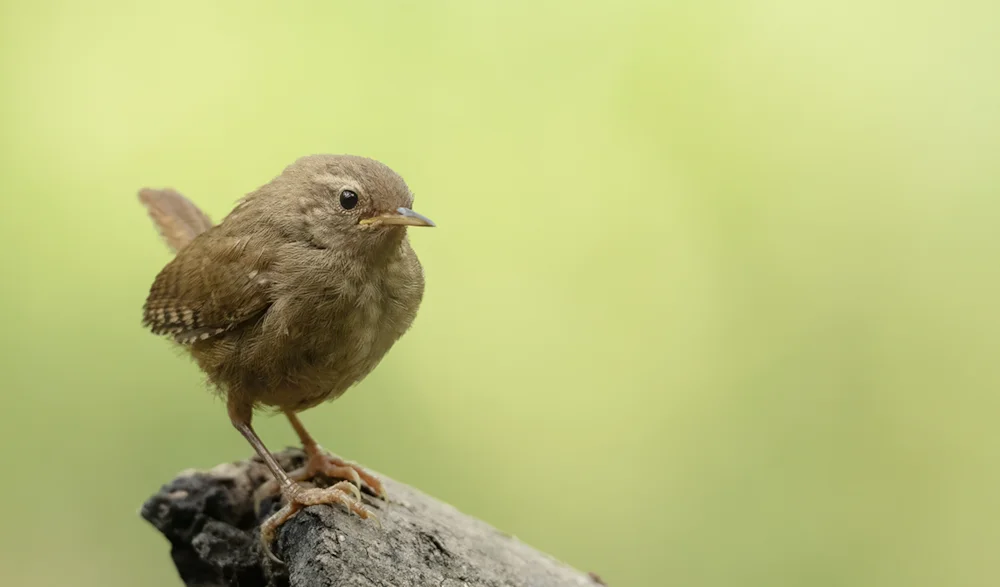
Soon after moving in, Lucy found herself acting as guardian to a family of Eurasian Wrens that nested in a bat box outside her bathroom window (Les Moxon).
Fledgling crisis
All was calm until 7 pm, when a Eurasian Sparrowhawk came shooting around the corner and went straight for one of the parents. Happening only 3 m away, it naturally made us both jump and I may have squealed. Like I said, I was invested. A tense few seconds passed where we weren't sure of the outcome, then the sparrowhawk departed, talons empty. The parent had made it into the box with no time to spare.
Then, about an hour later, we heard another kerfuffle above us. Sibling bickering erupted, and then – suddenly – one of the chicks was hanging by a claw out of the box. Unable to tell if it was ready to fledge and far too emotionally involved, in half a minute I was standing on the edge of the bath, hanging out of the window, gently shoving the little chick back through the gap. James built a crash pad beneath by moving various bits of furniture, and not too soon. Within 10 minutes it tumbled out again, this time on to the garden table, unable to fly but almost ready to do so. Of course, we intervened. It couldn't stay on the table (due to neighbourhood cats) or go back in the box, so it was placed gently in a nearby bush. The next day, the parents found it.
That is both the joy and peril of having a wildlife-friendly garden: the investment – both financially and emotionally – in every bird, frog, butterfly and bee. But when all is said and done, that's why most people do it. We like to think we're being selfless, sharing our patch of the world with nature, but we're getting as much out of it as they are. Still, there are worse hedonistic pleasures to have. You'll have to excuse me now – the hedgehog has just appeared.
- This column first appeared in the August 2026 edition of Birdwatch. To be the first to read the magazine each month, take out a subscription to Birdwatch, or get the magazine alongside your bird news by subscribing to either Bird News Ultimate (paper magazine) or Bird News Ultimate Plus (digital access).

